Samgyetang Recipe: Korean Ginseng Chicken Soup in 8 Steps
🇰🇷 Korean Classic🍲 One-Pot⏱ 85 Minutes🌿 Not Spicy
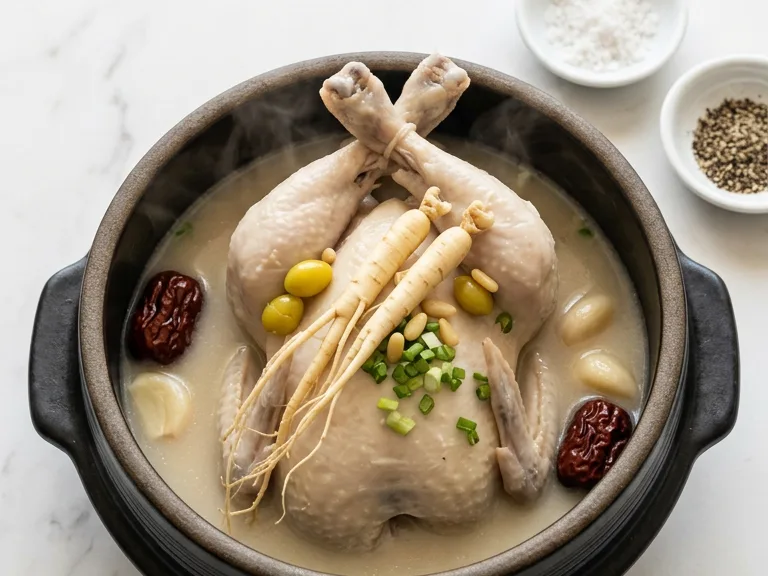
This samgyetang recipe is Korea’s answer to the hottest days of the year — a whole young chicken stuffed with glutinous rice, simmered with fresh ginseng until the broth turns milky white. Koreans eat it on boknal, the three dog days of summer, following the old saying i-yeol-chi-yeol: fight heat with heat. This is the single-serving home version, cooked start to finish in one earthenware pot — no separate stock, no herbal medicine packet, nothing to strain out.
🛒 1. Ingredients (Serves 1)
Everything this samgyetang recipe needs is listed below, for one whole chicken in one pot. Scale it by cooking a second pot rather than doubling into a big one — the broth behaves differently, and section 8 explains why.
| Ingredient | Amount | Notes & Substitutes |
|---|---|---|
| Young whole chicken | 1 (about 550g / 1.2 lb) | Cornish hen or poussin — see guide below 👇 |
| Glutinous rice | 5 Tbsp | Soaked 1 hour, then drained — see guide below 👇 |
| Fresh ginseng | 2 roots | Trim the hard crown — see guide below 👇 |
| Whole garlic cloves | 6 total | 3 inside the bird, 3 in the broth |
| Dried jujube | 4 total | 2 inside, 2 in the broth — see guide below 👇 |
| Water | 1.2 L (5 cups) | Enough to half-submerge the chicken |
| Chopped scallion | 1 Tbsp | Garnish, added at the very end |
| Ginkgo nuts (optional) | 5 | Always cooked, and only a few — see guide below 👇 |
| Pine nuts (optional) | 5 | Garnish only |
| Salt & black pepper | — | Served in a small dish, never added to the pot |

Notice what is not on that list: no onion, no leek, no ginger, no bagged herbal medicine mix. A single-serving samgyetang recipe cooks in the pot it is served from, so there is no straining step — and anything you cannot strain out will still be floating in your bowl at the table.
🧂 2. Can’t Find Korean Ingredients?
Only three items in this samgyetang recipe are genuinely Korean-market goods. Here is what each one tastes like, what to use instead — and what NOT to buy by mistake.
Raw ginseng root tastes earthy and faintly bitter first, then quietly sweet — closer to a parsnip crossed with tonic water than to anything sharp.
✅ Substitute: 4 slices of fresh ginger + 1 tsp honey. Ginger alone leaves only the heat; the honey rebuilds the sweet finish.
⚠️ Don’t buy: red ginseng extract, ginseng candy, or powdered ginseng — those are processed products and will turn the broth murky and medicinal.
Wrinkled red dates that go soft and honeyed in broth — think date meets apple skin, with almost no acidity.
✅ Substitute: Chinese dried red dates are the same fruit and work one-for-one. In a pinch, 1 dried apricot adds sweetness, but it also adds tartness the dish does not want.
⚠️ Don’t buy: fresh green jujube from the produce aisle — crisp and apple-like, it never gives up its sugar to the broth.
Short, chalk-white grains that turn sticky and translucent. This is the rice that becomes the porridge inside the bird.
✅ Substitute: sushi rice or arborio. Both hold their shape and drink the broth well, with a little less chew.
⚠️ Don’t buy: long-grain rice — it stays loose, escapes through the cavity, and clouds the broth with starch instead of thickening it.
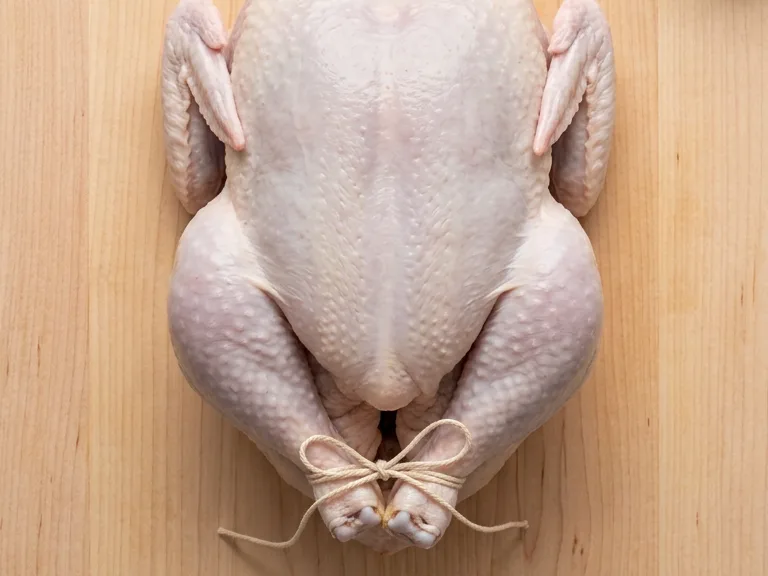
A samgyetang recipe lives or dies on bird size. Korean butchers sell a small bird, roughly 550g and 18cm long, sold cleaned with no head or feet.
✅ Substitute: a Cornish hen or poussin, 1.2–1.5 lb — same size, same timing, and stocked frozen in most Western supermarkets.
⚠️ Don’t buy: a standard 4 lb roaster. It will not fit an earthenware pot, and one hour will not cook the rice through inside it.
Jade-green kernels with a soft, slightly bitter bite. Purely a garnish — the dish is complete without them.
✅ Substitute: leave them out, or use pine nuts alone.
⚠️ Note: Koreans eat ginkgo nuts cooked and only a few at a time — never raw, never by the handful. Five per bowl is the traditional amount, and that is the amount used here.
🍳 3. Samgyetang Recipe — Step-by-Step Instructions
Eight steps, one pot. The only thing this samgyetang recipe asks of you in advance is the rice soak, so start that before anything else.
STEP 1🍚 Soak the glutinous rice
This samgyetang recipe starts an hour before the stove does. Rinse 5 Tbsp of glutinous rice, cover it with cold water, and leave it for 1 hour. Drain it in a sieve until it stops dripping. Unsoaked rice will still be hard at the centre after an hour of simmering, and it is the one mistake you cannot fix later.

STEP 2✂️ Trim the chicken and rinse the cavity
This is the only knife work a samgyetang recipe asks for. With kitchen shears, cut away the fatty tail and the loose flap of skin at the neck. Then hold the bird upside down under cold running water and rinse the cavity until the water runs clear. This is the step that decides whether your soup smells clean — the tail gland and leftover blood are where every off-flavour comes from.
STEP 3🥄 Stuff the rice, garlic and jujube
Spoon the drained rice into the cavity — 5 Tbsp, no more — then push in 3 whole garlic cloves and 2 jujubes. Leave a finger of room at the opening. Rice swells as it cooks, and a packed bird splits its skin and spills porridge into the broth.
STEP 4🧵 Tie the legs shut
Wrap plain cotton kitchen twine around both ankles twice and knot it. Korean cooks often cut a small slit in one drumstick and hook the other leg through it instead — either way, the cavity has to stay closed for the full hour, or the rice migrates into the soup.
STEP 5💧 Set it in the pot and add water
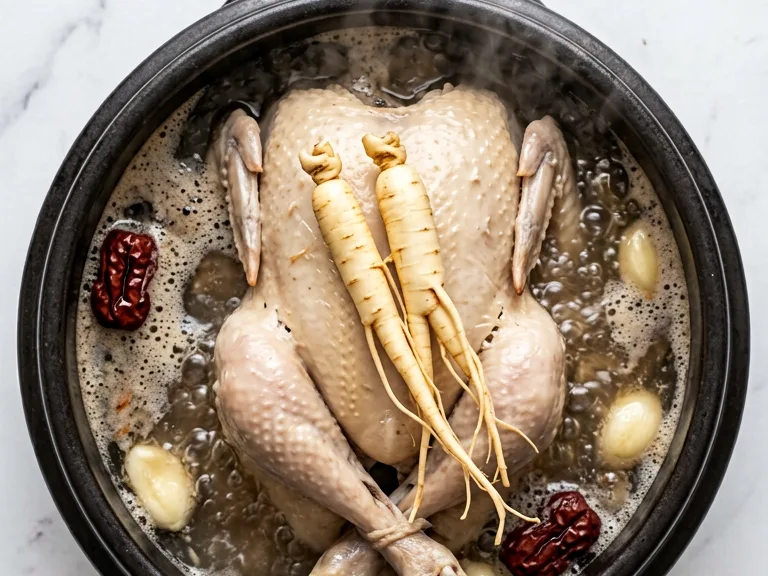
A samgyetang recipe is built around a small, deep vessel. Sit the chicken breast-up in a ttukbaegi (Korean earthenware pot) or any small, deep, heavy pot, and pour in 1.2L of cold water — the bird should sit half submerged, not swimming. Lay the 2 ginseng roots across its back, and drop the remaining 3 garlic cloves and 2 jujubes into the water around it.
STEP 6🔥 Bring to a boil and skim
Uncovered, over high heat, bring it to a full boil. Grey-brown foam will rise within a couple of minutes — lift it off with a ladle and discard it. Skimming is the difference between a clean white broth and a cloudy, faintly scummy one, and it takes about 2 minutes of attention.
STEP 7⏲️ Cover and simmer for one hour
This is the hour that makes the samgyetang recipe work. Drop the heat to low, put the lid on, and leave it for 1 hour, turning the chicken once around the halfway mark. Somewhere in the second half the broth stops being clear and turns opaque and milky. That colour is the whole point of the dish, and section 4 explains exactly what is happening in the pot.
STEP 8🌿 Garnish and bring the pot to the table
Scatter 1 Tbsp of chopped scallion, 5 ginkgo nuts and 5 pine nuts over the top and carry the pot straight to the table, still bubbling. Do not salt the broth. Salt and pepper go in a small dish on the side, and each person dips the meat as they eat — that is how this samgyetang recipe is meant to be finished.

💡 4. Tips for Success
✔ Why the broth turns white — and how to guarantee it. A samgyetang recipe has exactly one piece of physics in it. Collagen and fat render out of the skin and bones and emulsify into the water. Emulsions need gentle, sustained agitation, which is exactly what a covered low simmer provides. A rolling boil breaks the emulsion and a lidless pot loses the heat that drives it, so the broth stays thin and grey. Lid on, heat low, one full hour — that is the entire technique.
✔ Cold water in, always. Starting cold lets the collagen leach out slowly as the pot climbs to temperature. Pouring hot water over the bird seizes the skin shut and you lose most of the body of the broth.
✔ Trim the crown off the ginseng. The knobby top of the root is fibrous and carries a harsh bitterness. Snap it off before the root goes in the pot.
✔ Turn it once, not constantly. One flip at the halfway point cooks the breast and back evenly. Poking at it repeatedly tears the skin, and the skin is what is holding the rice in.
✔ Season at the table, not in the pot. A samgyetang recipe is seasoned in the bowl, not the pot, and salt drawn into the meat during cooking firms it up. Dipping each bite instead keeps the chicken soft and lets the broth stay clean enough to drink on its own.
🥡 5. Storage & Reheating
A samgyetang recipe is meant to be eaten the moment it leaves the stove, but leftovers keep well. Pull the meat off the bone, keep it in the broth, and refrigerate up to 3 days. The rice will drink up a good deal of the liquid overnight, so add a splash of water when you reheat and warm it over medium heat until it steams — never in a hard boil, which toughens the meat. Broth alone freezes cleanly for up to 1 month; the cooked rice does not, turning grainy on thawing.
🍚 6. What to Serve With
A bowl from this samgyetang recipe is a full meal on its own, so the table around it stays deliberately sparse:
- Kkakdugi (cubed radish kimchi) — crunchy and sour against the soft, rich broth. The classic pairing 🥬
- A dish of salt and coarse black pepper — not optional; this is the seasoning system for the whole meal 🧂
- Leftover broth as dakjuk — stir cooked rice into what is left in the pot for a chicken porridge the next morning 🍲
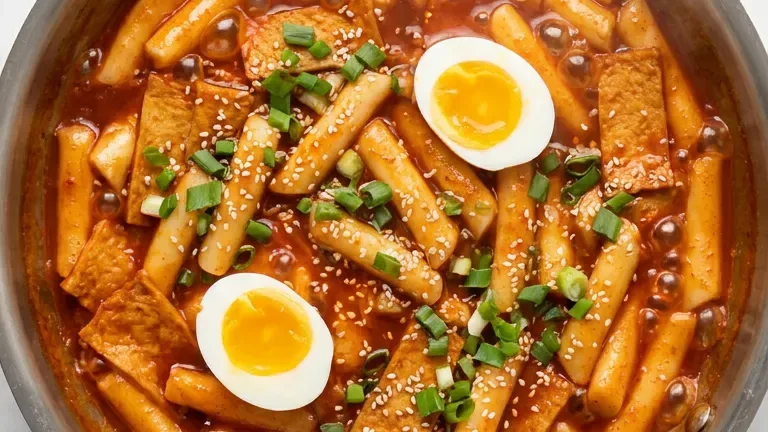
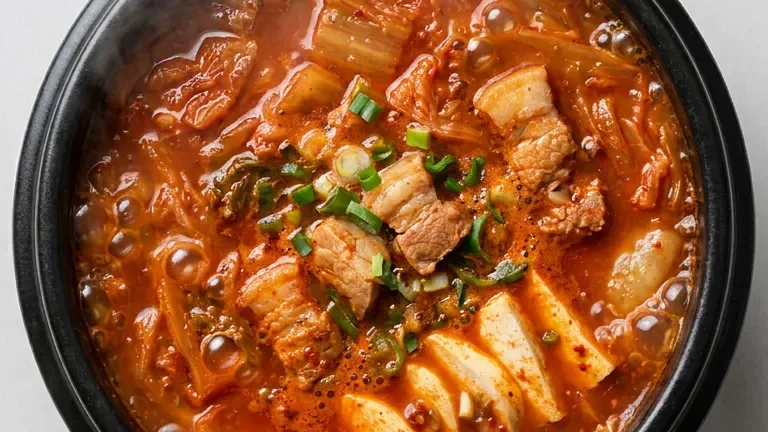
- Something spicy the day after, like kimchi jjigae or tteokbokki — Korean summer eating swings hard between the two 🌶
❓ 7. FAQ
❓ Can I make this samgyetang recipe without ginseng?
Yes, and it is a real version rather than a compromise. Use 4 slices of fresh ginger plus 1 tsp of honey in the broth. You lose the medicinal note and gain a cleaner, brighter soup — some Korean households prefer it that way.
❓ Why is my samgyetang broth not milky white?
Almost always one of three things: the lid was off, the heat was too high, or the hour was cut short. The white colour is an emulsion of rendered collagen and fat, and every samgyetang recipe needs a covered, gentle simmer to form it. Give it the full 60 minutes on low and it will arrive.
❓ What size chicken does a samgyetang recipe need?
About 550g, or 1.2–1.5 lb — a Cornish hen or poussin. A full-size roaster will not fit an earthenware pot and its rice will still be raw when the meat is done.
❓ Can I use a pressure cooker or an Instant Pot?
You can, and plenty of Korean cooks do. Run this samgyetang recipe at 20 minutes at high pressure with a natural release, and the meat will fall off the bone. The broth comes out thinner and less white, though, because a sealed cooker gives you almost none of the slow reduction that builds the emulsion.
❓ Is samgyetang spicy?
Not at all. There is no chili anywhere in it — it is one of the mildest dishes in Korean cooking, which is why it is served with kimchi on the side and why children eat it happily.
❓ Do you eat the ginseng root?
Most Koreans do, and this samgyetang recipe assumes you will. After an hour the root is soft and much less bitter than it smells. Chew it slowly, or leave it in the bowl — neither is wrong.
🎨 8. Make It Your Own — Variations & Upgrades
The one-pot samgyetang recipe above is the everyday home version. Here is how Korean kitchens actually vary it — pick one, not all four at once:
The whole samgyetang recipe in one breath: soak rice 1 hour → trim the tail and rinse the cavity → stuff 5 Tbsp rice with garlic and jujube → tie the legs → set in a pot with 1.2L cold water and ginseng on top → boil and skim → covered, low, 1 hour → scallion and nuts, salt at the table. One pot, one bird, milky broth.
Recipe notes: this samgyetang recipe is built from the single-serving earthenware-pot method used in Korean home kitchens, cross-checked against leading Korean recipe archives. In 2026 the three dog days fall on 15 July, 25 July and 14 August — the last of them, malbok, is when samgyetang shops see their longest queues. Nutrition values are approximate. Background reading on samgyetang and on the ginseng root itself. Fried chicken is the other Korean chicken classic — that one is yangnyeom chicken.