10,000 Steps a Day: Do You Need It, or Is 7,000 Enough?
10,000 steps a day is a round number, not a medical threshold. A 2022 meta-analysis of 15 cohorts found that the risk of dying during follow-up kept dropping as steps rose, then flattened at about 6,000 to 8,000 steps for adults aged 60 and older and 8,000 to 10,000 for younger adults. A 2025 review put the main bend at roughly 5,000 to 7,000. Below: what those studies measured, how steps convert to miles and minutes, and a 4-week plan that adds about 1,000 steps a week.
Quick answer
7,000–10,000 Daily steps where most of the measured benefit had already appeared
You do not need exactly 10,000: in pooled studies, risk kept falling up to about 6,000 to 8,000 steps for adults 60+ and 8,000 to 10,000 for younger adults.
Step ranges from Paluch et al., Lancet Public Health 2022 (15 cohorts, 47,471 adults) · distance and time worked out 2026-10-20 with a 2.5 ft (0.76 m) step and 100 steps/min

Where 10,000 steps a day comes from, and what it is not
The 10,000 figure is easy to remember and widely promoted, and plenty of people treat it as the line that separates active from inactive. Researchers have pointed out for years that the number was never derived from a dose-response study. A 2019 cohort study of older women in JAMA Internal Medicine opened by noting that the 10,000 goal has a limited scientific basis, even though the public widely believes it is necessary for health.
That does not make 10,000 a bad target. It means the number is one point on a curve, not a line between healthy and unhealthy. What the recent studies try to answer is where along that curve most of the benefit shows up, and whether the curve looks the same for a 35-year-old and a 70-year-old.
Steps versus the official activity guidelines
Public health guidelines are written in minutes, not steps. The CDC recommends that adults get 150 minutes of moderate-intensity aerobic activity such as brisk walking every week, which it illustrates as 30 minutes a day, 5 days a week, plus muscle-strengthening activities on 2 or more days. The World Health Organization uses the same 150-minute benchmark and counts adults below it as physically inactive; by its estimate, 31% of the world’s adults, about 1.8 billion people, fell short in 2022.
Steps and minutes overlap but measure different things. A step counter records every step, including the slow shuffle from the desk to the kitchen. The guidelines care about time spent at moderate effort or harder. A day of 9,000 slow steps can contain almost no brisk walking, while a day of 6,000 steps can include a solid 30-minute walk. Both numbers are useful, and the plan later in this article uses both.
Tip · Read your own baseline first Before choosing any target, wear the counter for 7 ordinary days and average them. Healthy adults in reference data range from roughly 4,000 to 18,000 steps a day, so a single number cannot fit everyone’s starting point.
What the research says about daily step counts
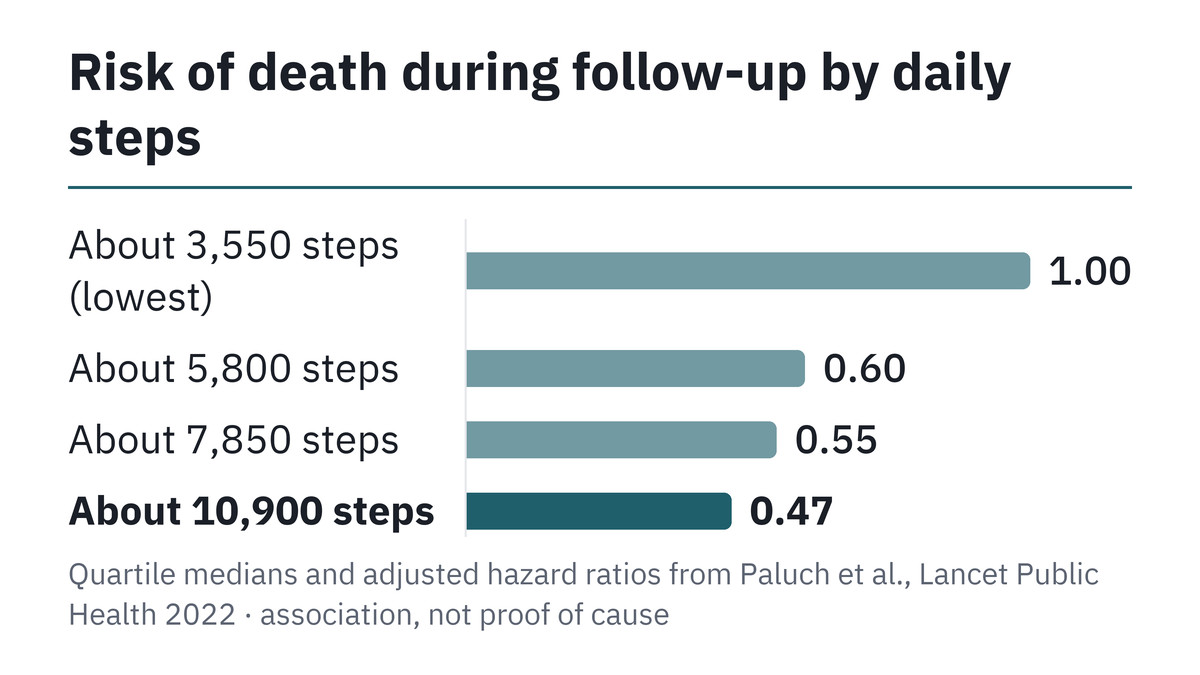
The most cited answer comes from a 2022 meta-analysis in The Lancet Public Health led by Amanda Paluch. Investigators pooled participant-level data from 15 cohorts covering 47,471 adults, with 3,013 deaths over a median follow-up of 7.1 years. Each person wore a device that counted steps, so the numbers come from measurement rather than memory.
The team split each study into quarters by daily steps. The median counts were about 3,553, 5,801, 7,842 and 10,901 steps. Compared with the lowest quarter, the adjusted hazard ratio for death from any cause was 0.60 in the second quarter, 0.55 in the third and 0.47 in the fourth. Put simply, the biggest drop came with the first move out of the least active group.
Age changes where the curve flattens
The same analysis modeled the curve by age. For adults aged 60 and older, risk kept falling until roughly 6,000 to 8,000 steps a day and then leveled off. For adults younger than 60, the leveling point was around 8,000 to 10,000. So the familiar round number sits at the upper end of the useful range for younger people and above it for older people.
A 2025 systematic review in the same journal, led by Ding Ding, widened the lens beyond death. It included 57 studies from 35 cohorts and found curves that bent at about 5,000 to 7,000 steps for all-cause mortality, cardiovascular disease, dementia and falls. Compared with 2,000 steps a day, 7,000 steps was linked with a 47% lower risk of death from any cause, 25% lower risk of cardiovascular disease and 22% lower risk of depressive symptoms. The authors concluded that 10,000 can still be a target for active people, while 7,000 may be a more realistic goal for some.
Older women: benefits from about 4,400 steps
The 2019 Women’s Health Study analysis led by I-Min Lee followed 16,741 women with an average age of 72. Women taking about 4,400 steps a day had lower death rates than those near 2,700, and rates kept falling until they leveled at roughly 7,500 steps. That study also found that once total steps were accounted for, walking faster was not clearly tied to lower mortality.
These are associations
All of these studies observed people; none assigned step counts at random. Healthier people may simply walk more. The pattern is consistent across cohorts, which is why guidelines take it seriously, but a step count is a habit to build, not a guaranteed result.
How steps convert to distance and minutes
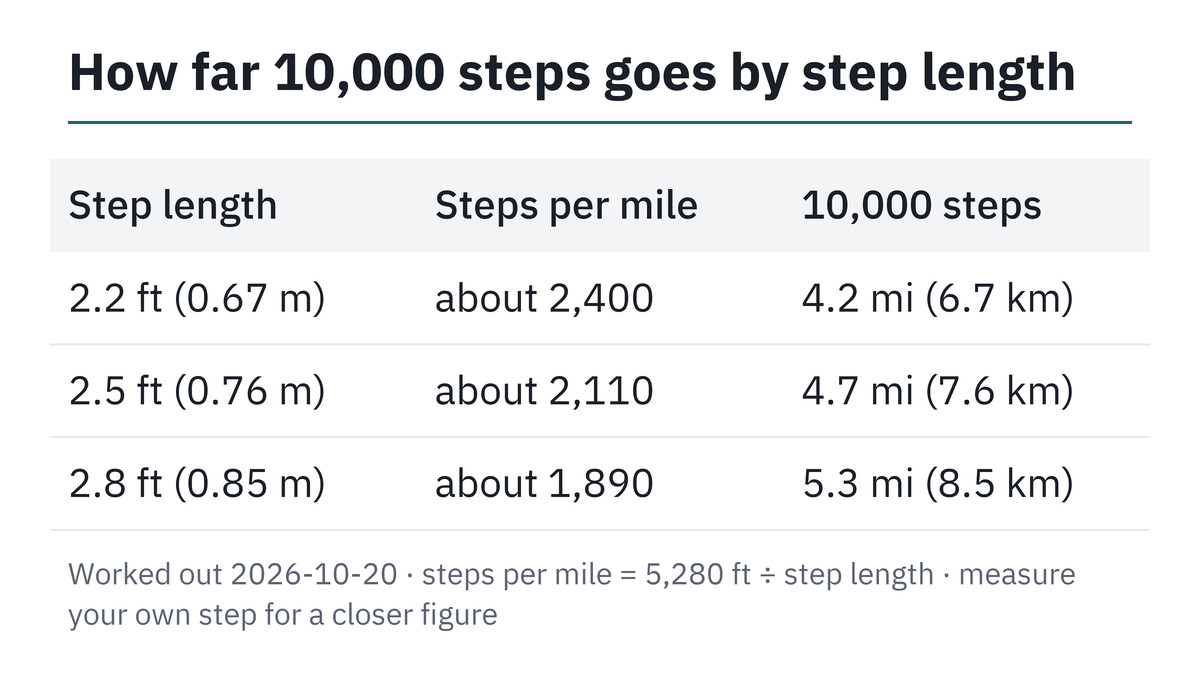
Step counts become easier to plan once you turn them into distance and time. Distance depends on your step length, which varies with height, leg length and pace. A common middle value for adults walking at a comfortable pace is about 2.5 feet (0.76 m) per step; that is an assumption used for the examples here, not a measured norm.
With a 2.5-foot step, one mile takes about 2,110 steps and 10,000 steps covers roughly 4.7 miles (7.6 km). Someone with a 2.2-foot step needs about 2,400 steps for the same mile, so their 10,000 steps cover around 4.2 miles. A taller walker with a 2.8-foot step covers about 5.3 miles.
Measuring your own step length
- Find a stretch you can measure, such as a running track or a marked 100-foot path
- Walk it at your normal pace and count your steps
- Divide the distance in feet by the number of steps
- Repeat once and average the two results
Time is the other half. Treadmill research by Catrine Tudor-Locke and colleagues in 2019 found that about 100 steps per minute is a reasonable floor for moderate-intensity walking in adults aged 21 to 40, and about 130 steps per minute marks vigorous intensity. At 100 steps per minute, 1,000 steps take about 10 minutes, so a 30-minute brisk walk adds roughly 3,000 steps.
| Walk | Pace | Approx. steps added |
|---|---|---|
| 10-minute walk | 100 steps/min | 1,000 |
| 20-minute walk | 100 steps/min | 2,000 |
| 30-minute walk | 100 steps/min | 3,000 |
| 30-minute walk | 120 steps/min | 3,600 |
A quick way to check your pace without a device: count steps for 15 seconds and multiply by 4. If the result is around 100 or more, you are likely walking briskly enough to count toward the 150-minute guideline. A 2011 review of step targets estimated that adults who meet that guideline in daily life usually log about 7,000 to 8,000 steps a day in total.
A 4-week plan to raise your daily steps
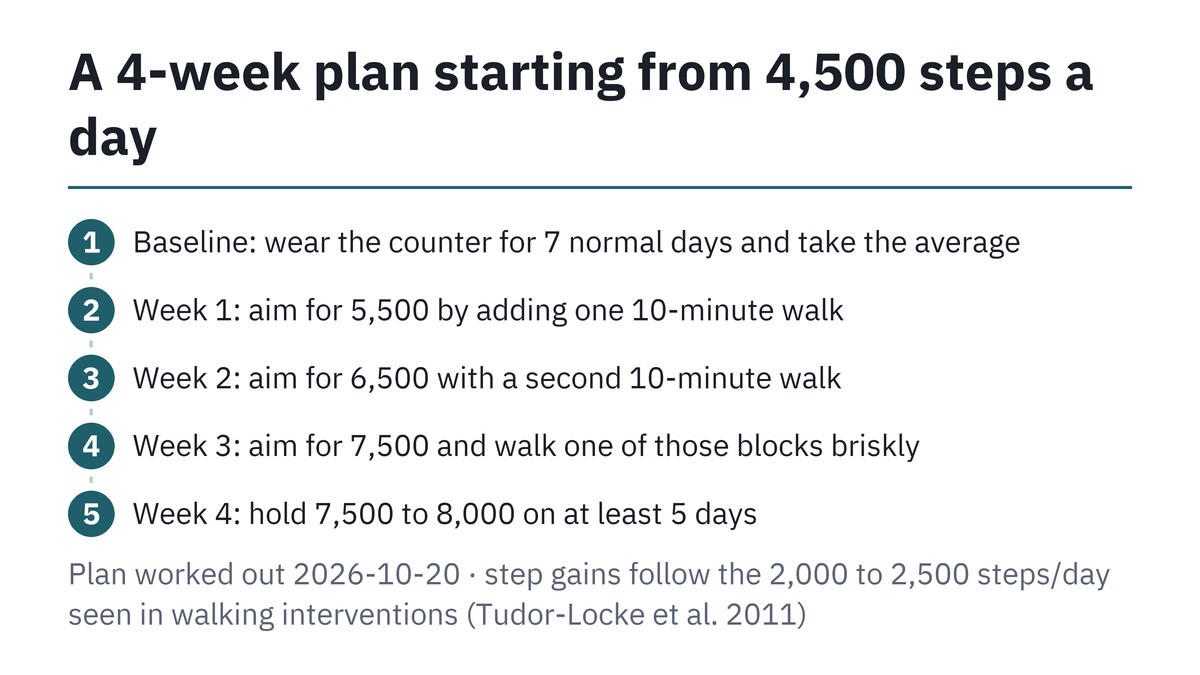
Walking programs studied in the research raise daily steps by roughly 2,000 to 2,500 on average. That is a useful ceiling for a first month. The plan below adds about 1,000 steps per week from a measured starting point, uses short walks you can schedule, and saves the brisk pace for week 3, once the habit is in place.
| Week | Daily target | What to add | Example from 4,500 |
|---|---|---|---|
| Week 1 | Baseline + 1,000 | One 10-minute walk | 5,500 |
| Week 2 | Baseline + 2,000 | Two 10-minute walks | 6,500 |
| Week 3 | Baseline + 3,000 | Make one walk brisk (100+ steps/min) | 7,500 |
| Week 4 | Hold week 3 on 5+ days | Add one longer weekend walk | 7,500 to 8,000 |
Where the extra 1,000 steps usually fit
- A 10-minute walk right after lunch or dinner
- Getting off transit one stop early, or parking at the far end of a lot
- Walking phone calls instead of seated ones
- A short loop before starting work at home
Short walks count. The step total does not care whether 3,000 steps come in one block or three. Splitting them helps people with busy days, and it matches the CDC’s framing of 30 minutes a day across 5 days. If you want to stack the walk onto an existing routine, the approach in our habit stacking plan works the same way for walking as for reading or journaling.
What to do after week 4
Once 7,500 to 8,000 feels normal, choose one direction. If you are under 60 and want more, keep adding about 1,000 steps every week or two toward 9,000 or 10,000. If you are 60 or older, holding 6,000 to 8,000 already sits in the range where the 2022 curve leveled off, and adding two strength sessions a week may matter more than extra steps.
How the plan shifts by starting point
| Situation | Typical start | Week-4 target | Main lever |
|---|---|---|---|
| Desk job, little walking | 3,500 | 6,500 | Two short walks a day |
| Age 60 or older | 4,500 | 7,000 to 8,000 | Walks plus 2 strength days |
| Already active | 9,000 | 9,000 to 10,000 | Make 30 minutes brisk |
| Returning after a break | 2,500 | 4,500 | 500 to 1,000 more per week |
Planning examples worked out 2026-10-20 · not measured group averages · ranges for 60+ follow Paluch et al. 2022
Common mistakes when chasing a step goal
The most common mistake is jumping straight from a low baseline to 10,000. Going from 4,000 to 10,000 in a week means about an hour of extra walking every day, which few schedules absorb. Sore feet and a missed day often follow, and the goal gets dropped entirely. Smaller weekly steps are more likely to stick.
The second mistake is treating all steps as equal. Ten thousand steps spread across slow errands is different from 7,000 steps that include a brisk 30-minute walk. The step research and the minutes-based guidelines agree on one point: some moderate effort in the week matters. Watch both the total and how many of those minutes were brisk.
Device accuracy and day-to-day swings
Phones and wrist devices count steps differently, and a phone left on a desk misses everything. Compare yourself with yourself, using the same device worn the same way. Expect daily totals to swing by a few thousand steps between workdays and weekends, which is why a weekly average is a fairer measure than any single day.
Weight goals are another source of frustration. Walking burns energy, but a step target alone rarely produces a large change on the scale without also looking at food intake. If weight loss is the aim, pair the walking plan with a realistic intake target such as the one in this guide to a safe weekly calorie deficit.
When to check with a clinician first
If you have chest pain or dizziness with exertion, a heart or lung condition, recent surgery, or joint pain that worsens with walking, talk with a doctor or physical therapist before raising your steps. Stop and seek care for chest pain, severe breathlessness or fainting.
Does pace matter, or only the total?
The evidence here is mixed, and it helps to be clear about that. In the 2022 meta-analysis, people with a higher peak 30-minute stepping rate had lower mortality even after adjusting for total steps, with a hazard ratio of 0.67 for the top quarter against the bottom. Yet time spent at 100 steps per minute or faster was not significantly linked to mortality once total steps were counted. The 2019 study of older women likewise found intensity was not clearly related once total steps were known.
A practical reading: total steps carry most of the signal in these data, and some brisk walking is a sensible addition because it is how most people reach the 150-minute guideline. For someone starting from a low baseline, adding steps at any pace comes first. For someone already near 8,000, making part of the walking brisk is often an easier next step than adding another 2,000.

Steps on busy or bad-weather days
Indoor options keep the weekly average steady: walking laps of a hallway or mall, using stairs, or marching in place during a show. None of these need to replace outdoor walks; they protect the streak on days when outdoor walks are not possible. A weekly average near the target is a better goal than seven perfect days.
Sources checked · 2026-10-20 checked
- Paluch et al. 2022, Daily steps and all-cause mortality: a meta-analysis of 15 international cohorts (Lancet Public Health) · PubMed
- Ding et al. 2025, Daily steps and health outcomes in adults (Lancet Public Health) · PubMed
- CDC: Adult activity, an overview · CDC
- WHO fact sheet: Physical activity (2024-06-26) · WHO
- Tudor-Locke et al. 2011, How many steps/day are enough? For adults (IJBNPA) · PubMed
- Steps-to-distance and steps-to-time conversions and the 4-week plan, worked out 2026-10-20 · Distance = steps × step length (2.2 / 2.5 / 2.8 ft) · steps per mile = 5,280 ÷ step length · time = steps ÷ 100 steps/min
- Women’s Health Study (16,741 women, mean age 72): about 4,40 · pubmed.ncbi.nlm.nih.gov
Try it with your own numbers:
- BMR and Daily Calorie Calculator — see how many calories your daily steps add on top of your base.
FAQ
Will walking 10,000 steps a day help me lose weight?
Do steps from housework and errands count?
Is running better than walking for step goals?
Should I aim for steps every single day?
In three lines
- 10,000 is a round goal, not a threshold; pooled studies show benefits leveling near 6,000 to 8,000 steps for adults 60+ and 8,000 to 10,000 for younger adults
- At a 2.5-foot step, 10,000 steps is about 4.7 miles, and 1,000 steps take about 10 minutes at 100 steps per minute
- Measure a 7-day baseline, add about 1,000 steps a week for 4 weeks, and make one daily walk brisk
By Jay · Runs the JLOGUE everyday guides · checks official sources
Read the abstracts of Paluch 2022, Ding 2025, Lee 2019 and Tudor-Locke 2011/2019, the CDC adult guidelines and the WHO fact sheet; conversions and plan worked out 2026-10-20 · Draft assisted by AI; figures, tables and links checked by hand.