Compound Interest Example: What Is $300 a Month in 20 Years?
Compound interest means you earn returns on your earlier returns, not just on the money you put in. Here is a worked compound interest example: invest $300 every month for 20 years at a steady 7% a year and the balance reaches about $156,278, even though only $72,000 came out of your pocket. Below are the formula, a year-by-year table, how 5% and 9% change the result, and what fees, a late start and debt do to the same math.
Quick answer
$156,278 = $72,000 deposited + $84,278 growth · 7% a year, 20 years
At a steady 7% a year compounded monthly, $300 a month for 20 years grows to about $156,278: $72,000 of your own deposits plus $84,278 of compound growth.
Future value of $300 deposited at the end of each month for 240 months, monthly compounding, no fees or taxes · calculated 2026-10-13 · definition from SEC Investor.gov
What compound interest is, with the $100 example
The SEC’s investor education site, Investor.gov, defines compound interest in one line: it is the interest you earn on interest. Its own example starts with $100 earning 5% a year. After the first year you have $105. After the second you have $110.25, because the 5% now applies to $105 instead of $100.
That extra 25 cents looks trivial, but it repeats every year on a bigger base. Investor.gov notes that the same $100, with nothing added, passes $162 after 10 years and nears $340 after 25 years. Simple interest, which pays only on the original deposit, would give $150 after 10 years: $5 a year, ten times.
| $100 at 5% | Simple interest | Compound interest |
|---|---|---|
| After 1 year | $105.00 | $105.00 |
| After 2 years | $110.00 | $110.25 |
| After 10 years | $150.00 | $162.89 |
| After 25 years | $225.00 | $338.64 |
The gap between the two columns is the whole story. It starts at zero, stays small for years and then widens quickly, which is why time matters more than almost any other input.
The $300-a-month example, step by step
Most people do not invest one lump sum; they add money every month. For regular deposits, the future value formula is FV = P × ((1 + r)^n − 1) ÷ r, where P is the monthly deposit, r is the annual rate divided by 12 and n is the number of months.
- Monthly deposit P = $300
- Monthly rate r = 7% ÷ 12 = 0.5833%, or 0.005833
- Number of deposits n = 20 years × 12 = 240
- Growth factor (1.005833)^240 ≈ 4.0387
- FV = 300 × (4.0387 − 1) ÷ 0.005833 ≈ $156,278
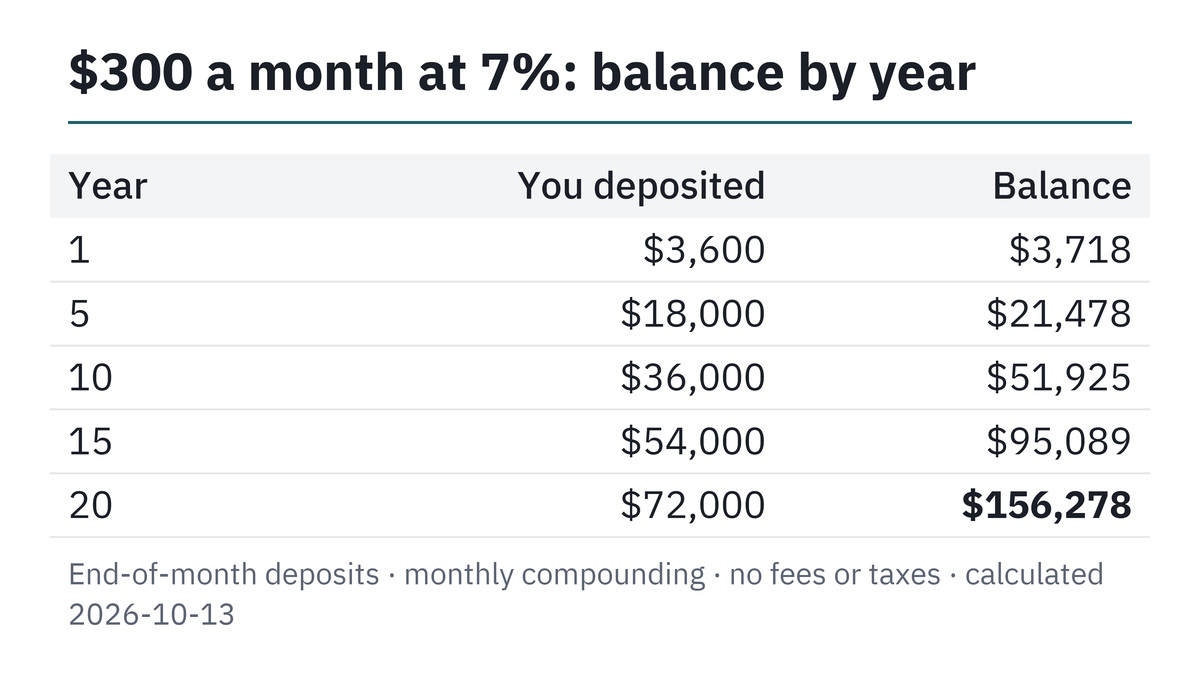
The table shows why patience pays. In year one, compounding adds only about $118 on top of $3,600 of deposits. In year 20 alone, growth adds roughly $10,400, almost three times what you deposit that year. The last five years add $61,189 to the balance, nearly three times the $21,478 built up in the first five.
This example assumes deposits at the end of each month. Depositing on the first of the month instead gives each payment one extra month of growth and lifts the 20-year result to about $157,190. The difference is small, so pick whichever date matches your paycheck.
5%, 7% or 9%: how the rate changes the answer
The 7% figure is an assumption, not a promise. Investment returns vary from year to year, and stock and bond funds can lose value. Running the same $300 a month through three different rates shows how sensitive the result is.
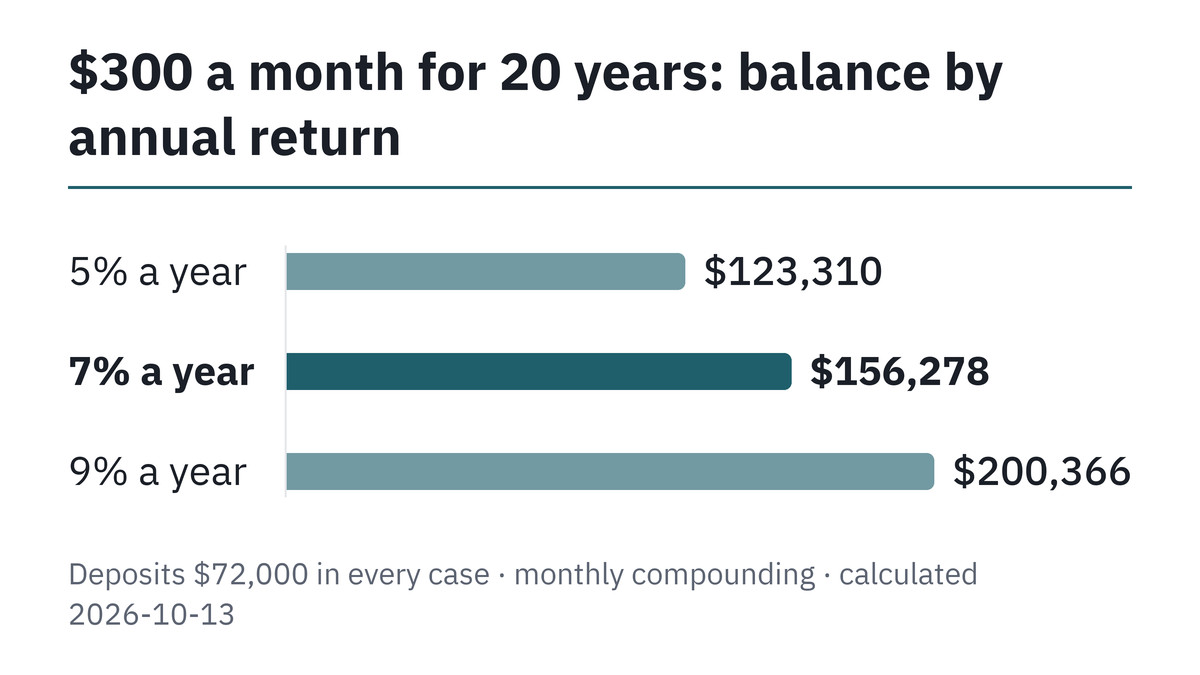
Going from 5% to 9% adds about $77,000 with exactly the same $72,000 of deposits. Investor.gov’s Rule of 72 gives a quick check: divide 72 by the annual rate to estimate how many years money takes to double. At 9% that is about 8 years; at 7% it is a little over 10; at 5% it is about 14.
Tip · Use a range, not one number Long-term planning works better with a low, middle and high case. If the plan only works at 9%, it is a fragile plan; if it still works at 5%, small surprises will not break it.
Fees and a late start cut the result
Fees compound too, in the wrong direction. A fund that earns 7% but charges 1% a year effectively leaves you with 6%. On the same $300 a month for 20 years, that turns the result into $138,612, about $17,666 less.

The SEC makes the same point in an investor bulletin. A $100,000 portfolio growing 4% a year for 20 years ends near $208,000 with a 0.25% annual fee, near $198,000 with 0.50% and near $179,000 with 1.00%. The bulletin explains that fees reduce the amount of money left in the portfolio to earn a return.
Starting late costs even more than fees, because it removes the most powerful years. $300 a month for only 10 years at 7% reaches about $51,925. Doubling the deposit to $600 a month for those 10 years still ends near $103,851, well short of the 20-year result despite the same total deposits of $72,000.
Same 7% return, different deposit plans
| Plan | Monthly deposit | Years | Balance at 7% |
|---|---|---|---|
| Half the deposit | $150 | 20 | $78,139 |
| Start 10 years later | $300 | 10 | $51,925 |
| Start late, deposit double | $600 | 10 | $103,851 |
| Keep going 10 more years | $300 | 30 | $365,991 |
End-of-month deposits · monthly compounding · no fees or taxes · calculated 2026-10-13
When compound interest works against you
The same math runs on debt. A credit card balance that is not paid in full is charged interest on the unpaid interest from earlier months. A $1,000 balance at 24% a year, compounding monthly at 2%, grows to about $1,268 after 12 months if no payments are made.
Inflation is the quieter downside. If prices rise 3% a year, the 20-year balance of the example is worth about $86,527 in today’s dollars. The nominal number still grows, but the buying power grows more slowly, which is why a savings goal should be checked against rising costs.
- High-interest debt: paying it off is a guaranteed return equal to its interest rate
- Inflation: compare returns with price growth, not with zero
- Taxes: interest in a regular taxable account is usually taxed each year, which slows compounding
- Withdrawals: taking money out early resets the base that future growth is built on
Where to put the money so it can compound
Where the $300 goes decides both the likely rate and the risk. Savings accounts and certificates of deposit at FDIC-insured banks are covered up to $250,000 per depositor, per bank, for each ownership category, but they usually pay less than a long-run stock market average. Stocks, bonds and mutual funds are not covered by deposit insurance, even when bought through a bank. To find the $300 in the first place, a simple split like the 50/30/20 budget rule is a common starting point.
| Option | Typical role | Risk to the $300 |
|---|---|---|
| High-yield savings account | Emergency fund, goals under 3 years | Low · FDIC insured up to limits |
| Certificate of deposit | Money with a fixed date | Low · early withdrawal penalty |
| Index fund in a retirement account | Goals 10 years or more away | Market ups and downs · not insured |

The habit matters more than the account. An automatic transfer on payday keeps deposits steady through good and bad markets, and steady deposits are what the formula assumes. Investor.gov’s free compound interest calculator lets you enter a starting amount, a monthly contribution, a number of years, an interest rate and a compounding frequency to test your own numbers.
Sources checked · 2026-10-13 checked
- SEC Investor.gov: What is compound interest? · Investor.gov
- SEC Investor Bulletin: How Fees and Expenses Affect Your Investment Portfolio (2025-07-23) · Investor.gov
- Future value of $300 a month at 5%, 6%, 7% and 9% for 10, 20 and 30 years, calculated 2026-10-13 · FV = P × ((1 + r)^n − 1) ÷ r · P = $300 · r = annual rate ÷ 12 · n = 240 → $156,278 at 7%
- Investor.gov’s compound interest calculator takes an initial · investor.gov
- FDIC deposit insurance covers $250,000 per depositor, per in · fdic.gov
FAQ
How much is $10,000 with compound interest over 10 years?
Is 7% a realistic return?
Does monthly or yearly compounding make a big difference?
How long does it take to double money at 6%?
In three lines
- Compound interest is interest earned on earlier interest, so time is the strongest input
- $300 a month for 20 years at 7% grows to about $156,278 from $72,000 of deposits
- Fees, a late start, inflation and high-interest debt all work against the same formula
Next: Emergency Fund: How Many Months (3–6) and Where to Keep It →
By Jay · Runs the JLOGUE everyday calculators · checks official sources
Checked SEC Investor.gov and FDIC pages; all balances calculated with the future value formula on 2026-10-13 · Draft assisted by AI; figures, tables and links checked by hand.