Zero Based Budgeting: How Do You Split a $3,000 Paycheck?
Zero based budgeting is a monthly plan in which your income minus every dollar you assign comes out to exactly zero. Savings and debt payments count as assignments, so zero does not mean spending it all. Below, a $3,000 take-home paycheck is split line by line: $2,000 to needs, $700 to savings and debt, $300 to wants. You will also find the five setup steps, how the method compares with the 50/30/20 rule, and where it tends to break down.
Quick answer
$0 unassigned $3,000 take-home − $3,000 assigned to categories
Give every dollar of the $3,000 a job: $2,000 to needs, $700 to savings and debt, $300 to wants, so income minus everything you assigned equals zero.
Example split worked out on 2026-10-13 for a $3,000 monthly take-home pay · method follows the CFPB budgeting steps · housing share compared with BLS Consumer Expenditures 2024

What zero based budgeting actually means
In a zero-based budget you start each month from nothing and assign a purpose to every dollar of expected income. Rent, groceries and the phone bill get a line, and so do the emergency fund, the extra credit card payment and the weekend spending money. When the sum of those lines equals your take-home pay, the budget is balanced at zero.
The word zero is about the math, not about your bank balance. If $250 goes to an emergency fund, that money still sits in a savings account at the end of the month; it simply has a job. A budget that leaves $400 floating with no label is the thing this method tries to prevent, because unlabeled money tends to leak into small purchases.
The Consumer Financial Protection Bureau (CFPB) describes budgeting as four pieces of work: record your income, log your spending, line up bills with their due dates, and then use a worksheet that pulls everything together into a working and realistic budget. Zero-based budgeting adds one rule on top: keep assigning until nothing is left over.
Tip · Use take-home pay, not salary Build the plan on the amount that actually lands in your account after taxes and payroll deductions. Using gross pay makes every category look affordable on paper and short in real life.
A $3,000 paycheck split, line by line
Here is one complete example for a single renter who brings home $3,000 a month. The amounts are a starting point worked out for this article, not a rule; your own rent and debts will move them around.
| Category | Monthly amount | Share of $3,000 |
|---|---|---|
| Rent and utilities | $1,050 | 35.0% |
| Groceries | $400 | 13.3% |
| Transportation (gas, transit, car insurance) | $300 | 10.0% |
| Health insurance and medical costs | $150 | 5.0% |
| Phone and internet | $100 | 3.3% |
| Debt payments | $200 | 6.7% |
| Emergency fund | $250 | 8.3% |
| Retirement savings | $150 | 5.0% |
| Sinking fund (car repairs, gifts, annual bills) | $100 | 3.3% |
| Personal spending | $200 | 6.7% |
| Eating out | $100 | 3.3% |
| Total assigned | $3,000 | 100% |
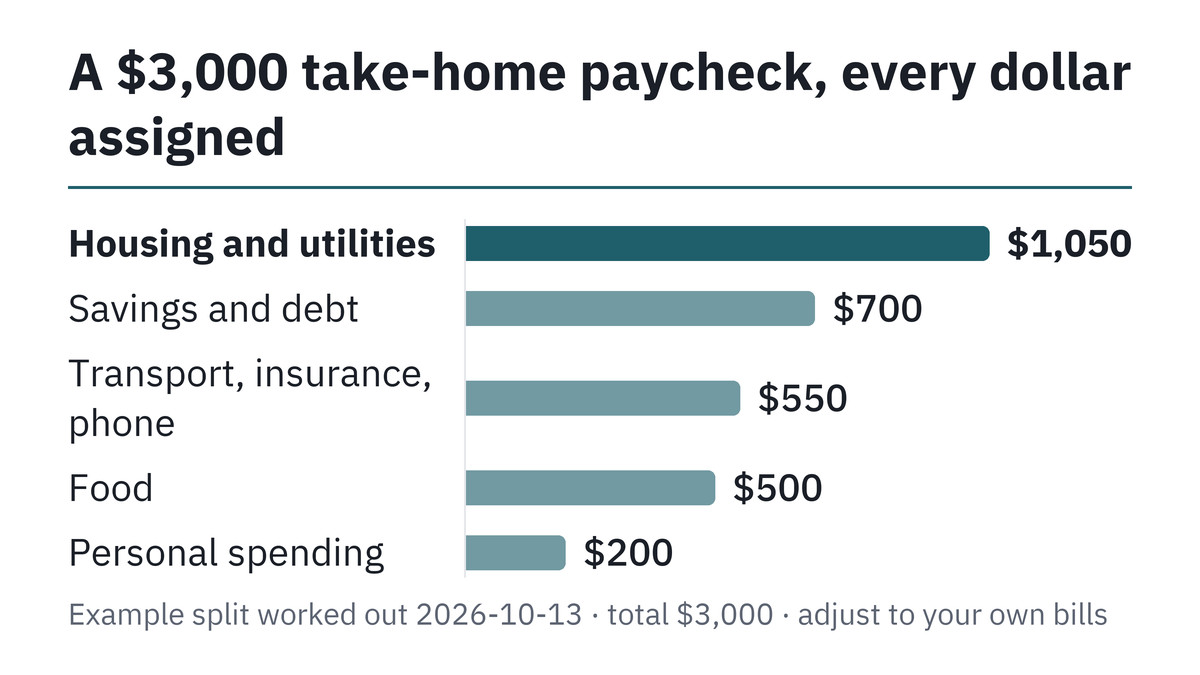
Housing takes the biggest slice at 35%. That is close to the national picture: in the Bureau of Labor Statistics Consumer Expenditure Survey for 2024, housing made up 33.4% of average household spending, ahead of transportation at 17.0% and food at 12.9%. If your rent is well above $1,050, the money has to come from somewhere else on the list, usually wants first and savings second.
Notice the sinking fund line. Car repairs, holiday gifts and once-a-year bills are not surprises; they are bills that arrive irregularly. Setting aside $100 a month means a $600 repair in month six is already paid for instead of landing on a credit card.
The $700 savings-and-debt bar in the chart combines four lines: $250 for the emergency fund, $150 for retirement, $100 for the sinking fund and the $200 debt payment. Together they send 23.3% of take-home pay toward the future.
How to set up a zero-based budget in five steps
The first month takes the longest because you are discovering where money goes. After that, most of the work is copying last month’s plan and adjusting a few lines.
- Write down the take-home pay you expect for the coming month, counting only money that is certain
- List fixed bills such as rent, insurance, phone and loan minimums, with the date each one is due
- Estimate variable costs like groceries and gas from the last one or two months of bank statements
- Assign what remains to goals in order: emergency fund, high-interest debt, retirement, then wants
- Subtract every assignment from income and keep adjusting until the result is exactly $0
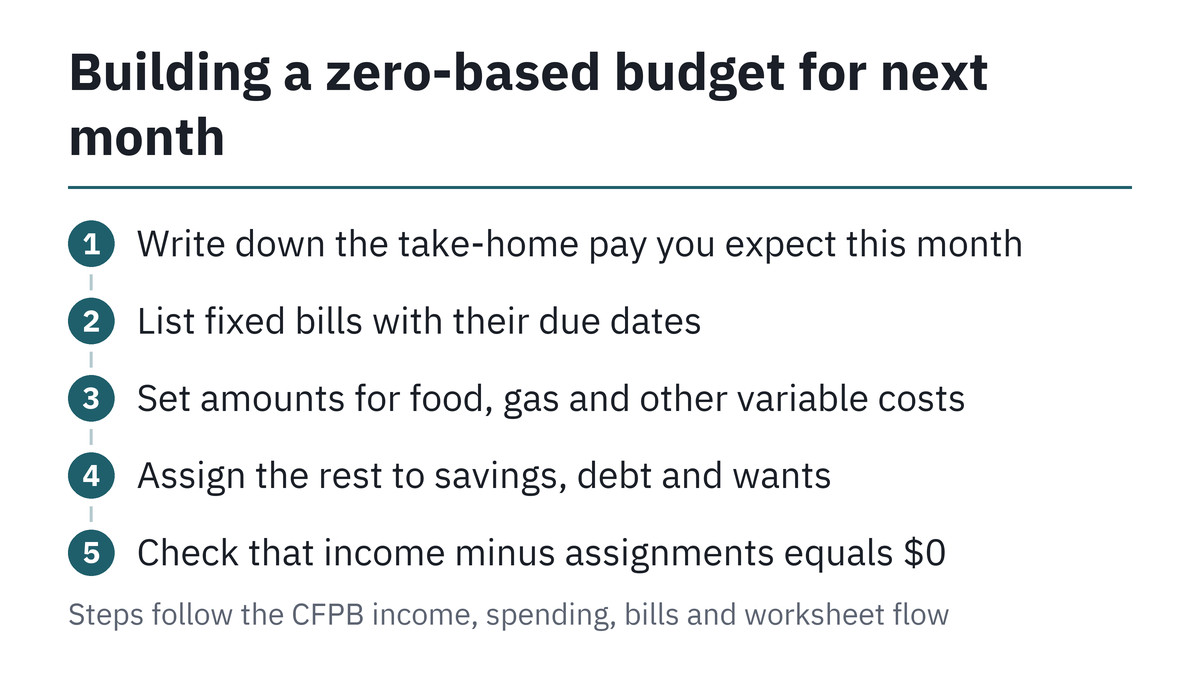
The CFPB calls logging your spending the heaviest lift of the whole process, and it suggests reviewing one week of receipts or bank activity at a time if a full month feels like too much. Its advice for staying with a new budget is simple: be realistic and look at your finances one month at a time.
Bill timing matters as much as the totals. If rent is due on the 1st and the paycheck arrives on the 5th, a budget that balances on paper can still overdraw an account. A short bill calendar next to the budget shows which week needs the tightest spending.
Tip · Leave a small buffer line A $25 to $50 line labeled miscellaneous absorbs the parking fee or birthday card you forgot, so one small surprise does not break the whole plan.
Zero-based vs the 50/30/20 and 70-10-10-10 rules
Percentage rules give you a quick split without listing every bill. The 50/30/20 rule sends half of take-home pay to needs, 30% to wants and 20% to savings and debt. The 70-10-10-10 rule, as it is commonly described, puts 70% toward living costs and 10% each toward savings, debt and giving or investing.
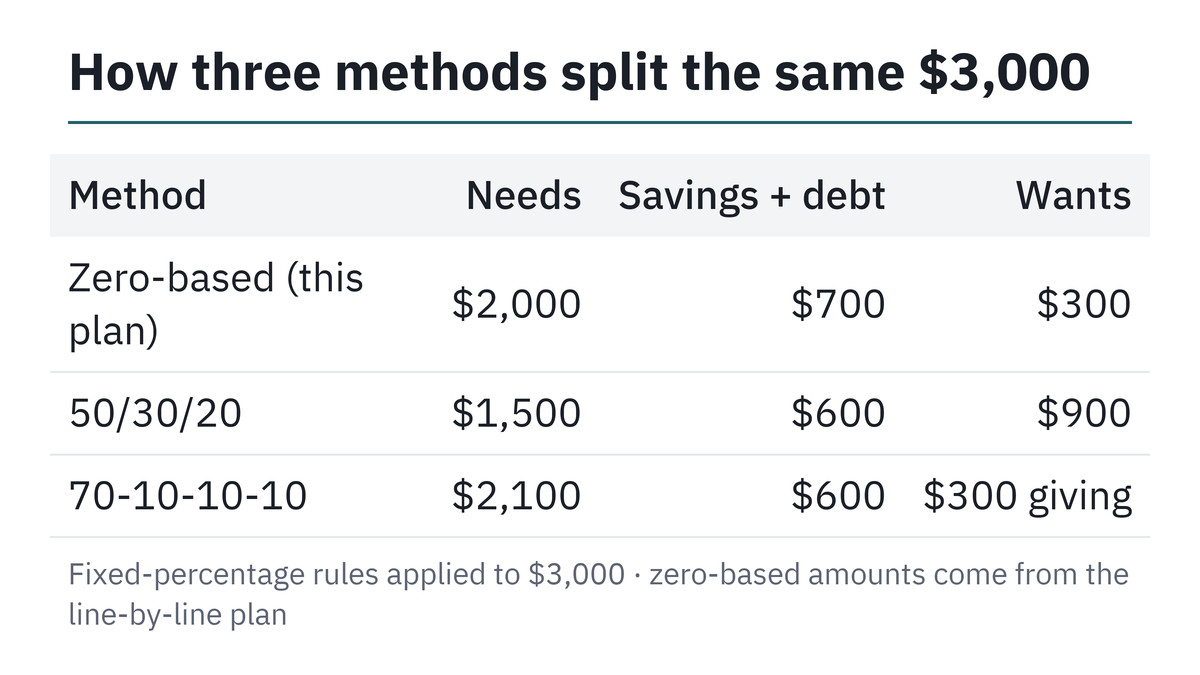
On $3,000, the 50/30/20 rule allows $1,500 for needs. With rent at $1,050, that leaves only $450 for groceries, transportation, insurance and the phone, which is too tight for many renters. A zero-based plan starts from the real bills instead, so it shows the gap immediately and forces a decision about where to cut.
The version taught by radio host Dave Ramsey follows the same income-minus-outgo-equals-zero idea and pairs it with his debt payoff steps. Apps built around the method work the same way: income goes in, categories come out, and the screen shows how much is still waiting for a job.
How the $3,000 plan shifts by situation
| Situation | Needs | Save + debt | Wants |
|---|---|---|---|
| Shared apartment | $1,700 | $950 | $350 |
| High-rent city | $2,300 | $500 | $200 |
| Paying off a card | $2,000 | $850 | $150 |
| No car | $1,700 | $950 | $350 |
Planning examples on $3,000 take-home pay · each row adds up to $3,000 · needs include rent of $750 / $1,350 / $1,050 / $1,050 · $600 of the card row’s $850 goes to debt · not measured household data
Downsides of zero-based budgeting and how to handle them
The method has real costs. It takes more time than a percentage rule, it can feel rigid, and a single unplanned expense can make the whole plan look wrong. People also tend to underestimate variable categories like groceries in the first two or three months.
Time: plan for about an hour in month one, then 15 to 20 minutes for each later month. Rigidity: when one category runs over, move money from another line instead of abandoning the plan. Underestimates: raise any category that runs over three months in a row rather than fighting it. Burnout: keep a personal spending line so the budget is not all bills and no life.

A CFPB worksheet on managing spending recommends comparing actual spending with the budget monthly or more often, and adjusting the budget if it is regularly out of line. That check is where zero-based budgeting earns its effort: every overspent line points to a specific number you can change.
The main advantage is visibility. Because every dollar is labeled, the plan shows exactly what an extra $100 toward debt or savings would cost elsewhere, which makes trade-offs concrete instead of vague.
When pay is irregular or arrives every two weeks
Zero-based budgeting assumes you know next month’s income, which is easy with a fixed salary and harder with tips, gig work or commissions. The usual fix is to budget on your lowest typical month and treat anything above it as extra to assign once it actually arrives.
Biweekly pay creates a different pattern. Two paychecks of $1,500 cover the $3,000 plan in most months, but twice a year a third paycheck arrives. Assigning that third check in advance, for example to the emergency fund or a debt balance, keeps it from disappearing into everyday spending.
An emergency fund makes irregular income easier to manage. The CFPB notes that the right size depends on your situation and that even a small amount can provide some financial security, so the $250 line in the example is a reasonable place to start rather than a target to hit all at once. A starter cushion also matters here — see how many months of expenses to keep in an emergency fund.
Sources checked · 2026-10-13 checked
- CFPB: Budgeting, how to create a budget and stick with it · CFPB
- BLS: Consumer Expenditures 2024 news release · BLS
- Line-by-line split of a $3,000 take-home paycheck and the 50/30/20 and 70-10-10-10 comparisons, worked out 2026-10-13 · Shares = category ÷ $3,000 · needs $2,000 + savings and debt $700 + wants $300 = $3,000
- CFPB recommends comparing actual spending with the budget mo · files.consumerfinance.gov
- The right emergency fund size depends on the situation, and · consumerfinance.gov
FAQ
Is zero-based budgeting better than the 50/30/20 rule?
What happens to money left at the end of the month?
Do I need an app for a zero-based budget?
How long does it take before the budget feels accurate?
In three lines
- Income minus every assigned dollar should equal zero; savings and debt payments count as assignments
- A $3,000 take-home example: $2,000 needs, $700 savings and debt, $300 wants
- Compare actual spending with the plan at least monthly and move money between lines instead of quitting
By Jay · Runs the JLOGUE everyday calculators · checks official sources
Checked CFPB guides and the BLS Consumer Expenditures 2024 release; example split calculated 2026-10-13 · Draft assisted by AI; figures, tables and links checked by hand.