Cat Food Calculator: Daily Feeding Amounts by Weight (2026)
A cat food calculator exists because cats are small, and small errors matter. Twenty extra calories a day is a rounding error on a Labrador and a weight problem on a 10 lb cat. The arithmetic is the same one veterinary nutritionists use: weight in kilograms to the power of 0.75, times 70, times a life-stage factor, divided by the calories in the food. What comes out is a daily portion in grams and ounces.
I wrote the calculator this article links to and then went looking for how badly the numbers usually miss. Cornell’s Feline Health Center supplied the uncomfortable answer: one of its clinicians estimates that around half the cats seen in veterinary clinics are overweight or obese, and names free feeding as a major cause. That is not a portion-size problem. It is a bowl-that-is-never-empty problem, which is why this guide spends as much time on how you feed as on how much.
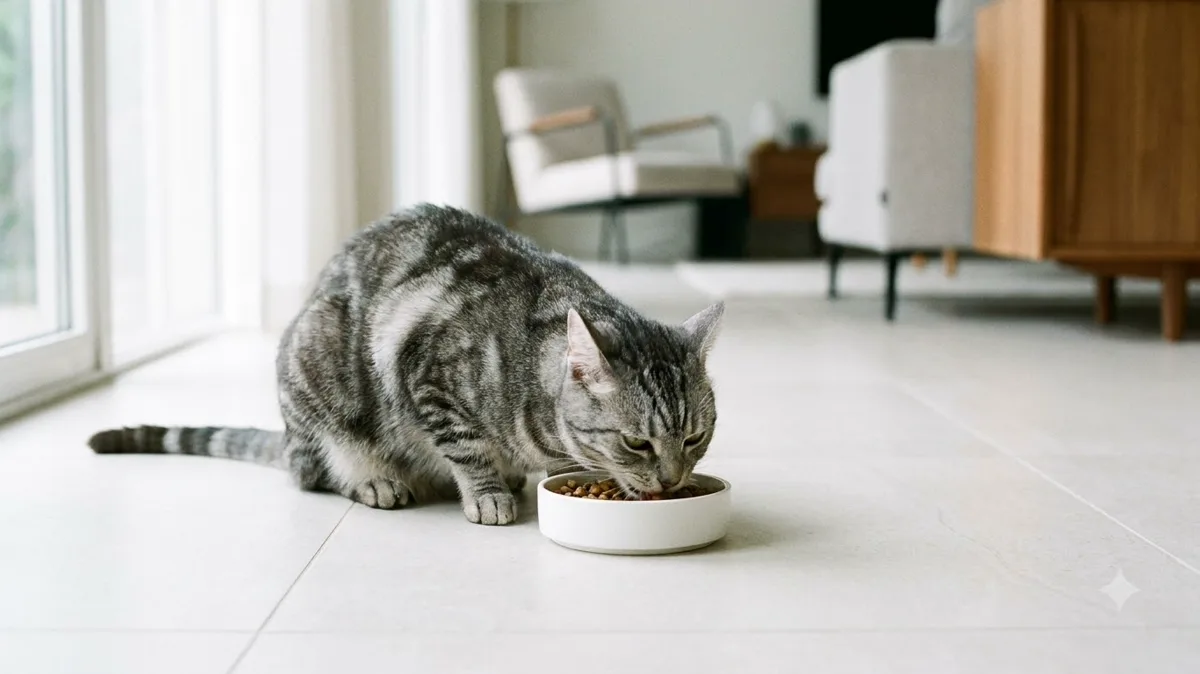
A 10 lb (4.5kg) neutered indoor adult cat burns roughly 218 calories at rest and about 262 calories a day once a low-activity factor is applied. On a dry food at 350 kcal per 100g that is about 75g, or 2.6 oz, split into two measured meals. On a canned food at 85 kcal per 100g the same cat needs roughly 308g, or 10.9 oz.
Those numbers describe a healthy adult at a stable weight. Kittens, seniors, pregnant queens and any cat on a prescription diet fall outside them, and Cornell is explicit that a weight-reduction plan should run under a veterinarian’s direction.
🐈 What a cat food calculator is really solving
1-1. 💧 Wet and dry food are not comparable by volume
Cornell’s Feline Health Center gives the numbers that make this obvious. Dry cat food contains between six and ten per cent water. Canned food has a moisture content of at least seventy-five per cent, which Cornell notes makes it a good dietary source of water. Two bowls that look identical can therefore differ by a factor of four in calories.
That is the whole case for using a cat food calculator instead of eyeballing a portion. Volume tells you nothing across food types. Calories do. Once you know the target calories, the weight of food follows from the energy density printed on the label — and only then.
1-2. 🥩 A cat is not a small dog
Cornell describes cats as having evolved as hunters eating prey high in protein, moderate in fat and minimal in carbohydrate, and says their diet still requires those general proportions. Two practical consequences follow. Protein content is not a marketing number for cats, and a food formulated for dogs is not a substitute in a pinch.
The other consequence is water. Cornell states plainly that cats should have access to clean, fresh water at all times, and that canned food’s moisture is a real contribution to intake. If your cat eats only dry food, water bowls stop being decoration and start being part of the diet.
🧮 The formula and the multipliers
2-1. ✏️ Resting energy requirement
Ohio State University’s Veterinary Medical Center publishes the calculation for dogs and cats together: multiply body weight in kilograms raised to the three-quarter power by 70. Their worked example uses a 10kg dog and lands at about 400 calories, and the same equation applied to a 4.5kg cat gives roughly 218 calories.
The exponent matters more for cats than for dogs precisely because cats cluster in a narrow weight band. Between an 8 lb cat and a 14 lb cat the resting requirement rises by about 52 per cent, not 75 per cent. A heavier cat needs proportionally fewer calories per pound, which is exactly the opposite of what most owners assume when a cat starts gaining.
2-2. ⚖️ The life-stage factors this calculator uses
Ohio State describes the second step as multiplying the resting figure by factors to estimate total daily energy needs, and shows those factors as a table rather than as prose. Published tables differ between sources, so here is exactly what our cat food calculator applies, stated as our assumption rather than as a universal standard.
| Life stage | Neutered | Intact | Typical cat |
|---|---|---|---|
| Kitten, under 1 yr | 2.5 | 2.5 | 3–4 meals a day |
| Adult, low | 1.2 | 1.4 | Indoor, sleeps a lot |
| Adult, normal | 1.4 | 1.6 | Indoor, daily play |
| Adult, high | 1.6 | 1.8 | Indoor-outdoor, hunts |
| Senior, 11+ yrs | 1.2 | 1.4 | Watch weight loss |
Multipliers used by the jwiseflow cat food calculator. Other published tables differ; treat any single set as an estimate and let a body-condition check overrule it.
2-3. 🏷️ Getting the calorie number off the can
AAFCO’s label rules require the calorie statement to appear under a heading titled “Calorie Content”, expressed in kilocalories per kilogram of food as fed and also per familiar unit such as a can or a cup. Divide the kcal/kg figure by ten and you have kcal per 100g, which is what the calculator asks for.
Check the adequacy statement while you are there. The FDA explains that “complete and balanced” requires meeting one of AAFCO’s Cat Food Nutrient Profiles or passing a feeding trial using AAFCO procedures, and that the profiles were last updated in 2016. The FDA also gives a worked example for cats: the adult-maintenance profile sets a minimum of 26 per cent crude protein on a dry matter basis.
Run your cat’s numbers in the free cat food calculator →
One note before you open it: the weight field is metric, so divide pounds by 2.205 first, or read the conversion off the chart below. For the calorie box, use the kcal/kg figure from the Calorie Content statement divided by ten.
Ad
 MEDIHEAL Essential Mask Sheet, 10 + 15% off with code JXLAB0306View details ›
Affiliate link — I may earn a commission.
📊 Daily amount by weight — wet and dry
3-1. 📐 The chart for a neutered indoor adult
This assumes a neutered adult cat at a healthy weight with low activity — the honest default for an indoor cat — using a factor of 1.2. The dry column uses 350 kcal per 100g and the wet column 85 kcal per 100g — the same defaults the calculator starts with. Both are common label values, but check yours.
| Weight | Daily calories | Dry per day | Wet per day |
|---|---|---|---|
| 6 lb 2.7 kg | 178 kcal | 1.8 oz 51 g | 7.4 oz 209 g |
| 8 lb 3.6 kg | 221 kcal | 2.2 oz 63 g | 9.2 oz 260 g |
| 10 lb 4.5 kg | 262 kcal | 2.6 oz 75 g | 10.9 oz 308 g |
| 12 lb 5.4 kg | 299 kcal | 3.0 oz 85 g | 12.4 oz 352 g |
| 14 lb 6.4 kg | 336 kcal | 3.4 oz 96 g | 13.9 oz 395 g |
| 18 lb 8.2 kg | 406 kcal | 4.1 oz 116 g | 16.9 oz 478 g |
Calculated with RER = 70 × kg^0.75 and a neutered low-activity factor of 1.2. Dry at 350 kcal/100g, wet at 85 kcal/100g — the calculator’s own defaults. An 18 lb cat is almost certainly overweight — see the note below before feeding to that row.
3-2. 🚫 Feed the target weight, not the current one
The bottom row of that table is a trap, and it is worth saying out loud. Cornell defines feline obesity as body weight twenty per cent or more above normal, and describes a nine-point body condition score where anything above about 6.5 to 7 counts as overweight. An 18 lb domestic cat is usually well past that line.
Feeding an overweight cat the maintenance calories for its current weight keeps it exactly where it is. But cutting calories on your own is not the fix either: Cornell states that any feline weight-reduction programme should be carried out under the direction of a veterinarian. Use the calculator to see the gap, then take that number to an exam.
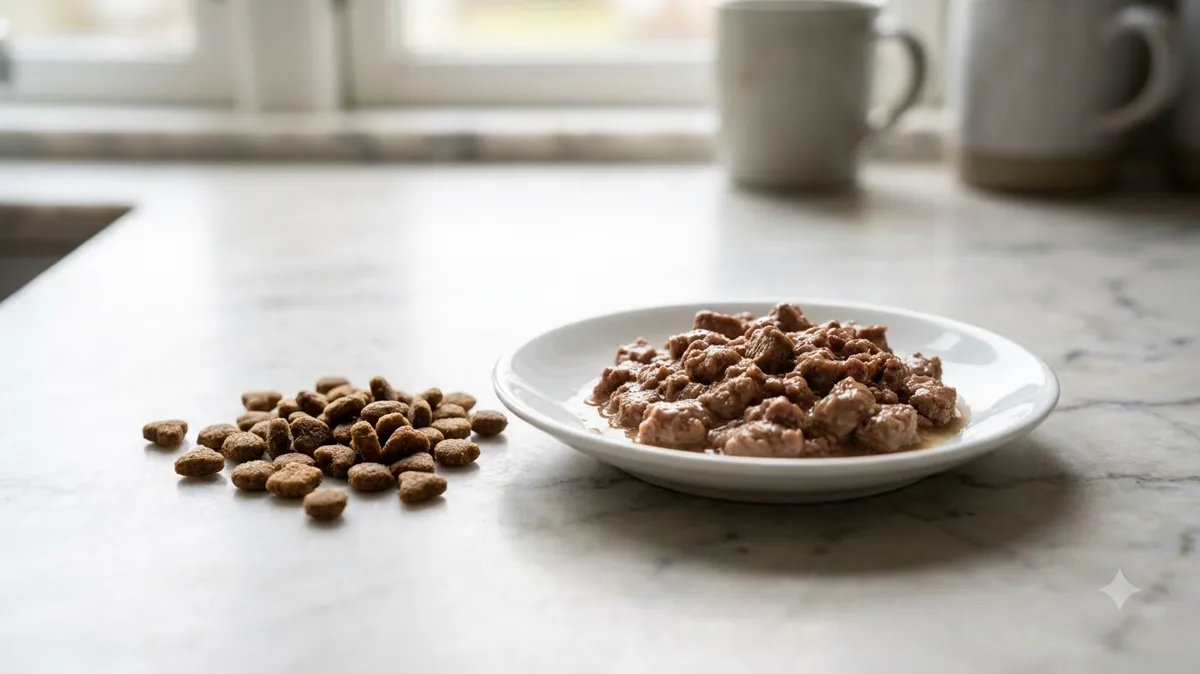
⚠️ Free feeding is the real problem
4-1. 🥣 What Cornell actually says about the full bowl
Cornell’s obesity page names the practice directly: a major factor responsible for feline obesity is free feeding, in which a bowl of dry food stays available all day. Carolyn McDaniel, VMD, a lecturer in clinical sciences at Cornell’s College of Veterinary Medicine, is quoted saying that probably fifty per cent of cats seen at veterinary clinics are overweight if not obese, and that canned food encourages feeding meals rather than letting a cat graze.
Her recommendation is blunt: we should be feeding meals to our cats rather than allowing them to eat whenever they want, with a distinct meal time that the owner controls. A perfect portion in a bowl that is topped up at midnight is not a portion. This is the one change that makes a cat food calculator worth running at all.
4-2. 🤔 My rule, and the foods that never go in the bowl
Here is the judgement I will defend: weigh the food once, on a kitchen scale, and put the scoop away. Cats eat portions small enough that a scoop’s error — easily fifteen or twenty per cent — is the entire difference between maintenance and slow gain. Feed the calculated amount for two weeks, then check the ribs and the waistline rather than the number.
The AVMA’s household hazards list includes alcohol, chives, chocolate, coffee, fatty foods, garlic, grapes and raisins, macadamia nuts, onions, salty snacks, tea, yeast dough and any product containing xylitol. The ASPCA notes that chocolate, coffee and caffeine share a methylxanthine risk, and that baking chocolate and cocoa powder carry the highest concentrations.
One hazard is specific to cats and is not a food at all. The AVMA warns that certain lilies of the Lilium and Hemerocallis genera are highly toxic to cats and can cause kidney failure even in small amounts. If you keep cut flowers, check the bouquet. If a cat has chewed one, call the clinic immediately rather than waiting for symptoms.
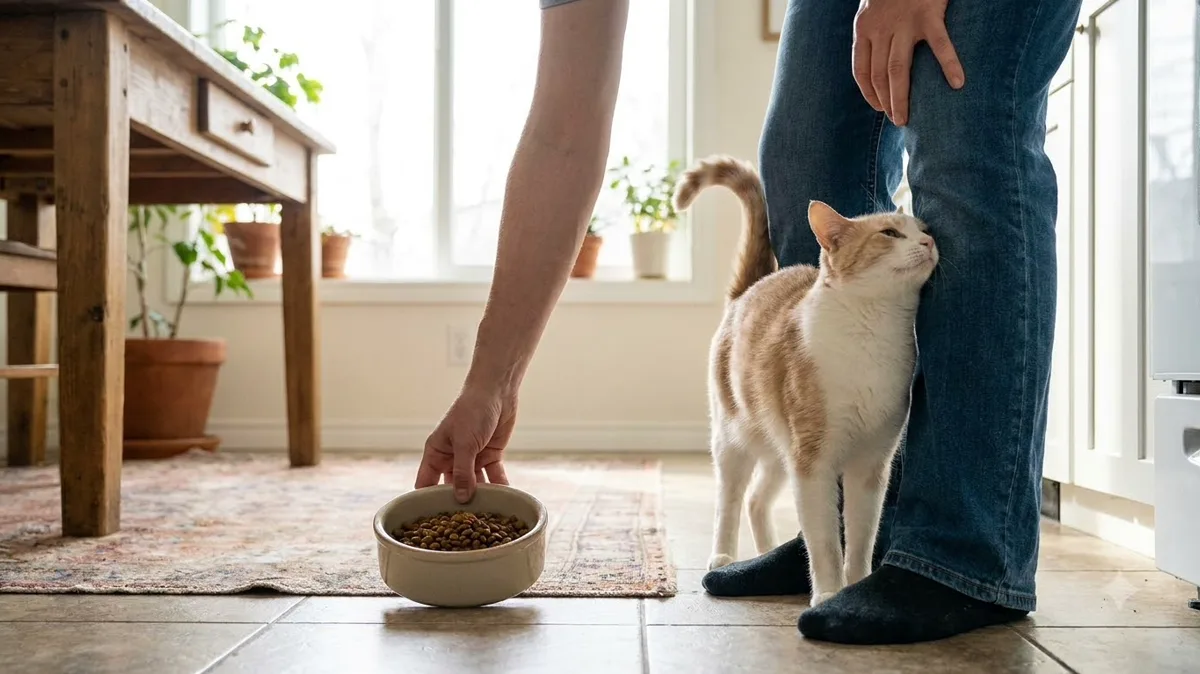
🐾 Kittens, seniors and indoor cats
5-1. 🍼 Kittens change the answer monthly
A kitten carries the highest factor in the table and gains weight fast, so the portion calculated this month is wrong next month. Re-run the cat food calculator with each new weight and split the total across three or four meals. Choose a food formulated for growth as well: the FDA notes that AAFCO maintains separate profiles for growth and reproduction and for adult maintenance, and they are not interchangeable.
Kittens are also where the free-feeding habit starts. A kitten that has always had a full bowl is a much harder adult to put on measured meals, so the meal structure is worth establishing before the growth factor drops away.
5-2. 🏠 Indoor life and the quiet surplus
The default indoor-cat factor in our table is 1.2, not 1.4, and the difference is deliberate. On a 10 lb cat those two factors are 262 and 306 calories — a gap of about 13g of dry food a day. Fed for a year, that is the kind of surplus that turns a 10 lb cat into an 11 lb cat without anyone changing anything.
Seniors need the opposite watchfulness. Cornell’s material on feeding and obesity is aimed mainly at excess, but an older cat losing weight on an adequate portion is a clinical sign, not a feeding problem. Weigh monthly, write the number down, and take a downward trend to a veterinarian rather than to a bigger bowl.
❓ Cat food calculator FAQ
6-1. ❓ How much should I feed my cat each day?
Work out 70 × weight-in-kg^0.75, multiply by the life-stage factor, then divide by the food’s calories per 100g. A 10 lb neutered indoor adult on a 350 kcal/100g dry food lands near 75g, or 2.6 oz, a day. Weigh it rather than scooping it, and split it into at least two meals.
6-2. ❓ Why does the wet food column look so much bigger?
Because canned food is at least seventy-five per cent water, per Cornell, while dry food is six to ten per cent. The calories are what the cat needs; the weight on the plate is a consequence of the moisture. A cat eating 10.9 oz of wet food and one eating 2.6 oz of dry food can be getting the same energy.
6-3. ❓ Can I leave dry food out all day instead?
Cornell identifies free feeding as a major factor in feline obesity and recommends distinct, owner-controlled meal times instead. If your household genuinely cannot manage scheduled meals, weigh the whole daily allowance into the bowl once and do not top it up — that keeps the total honest even if the timing is not.
6-4. ❓ Is a cat food calculator better than the label chart?
It is more specific. AAFCO requires feeding directions on complete and balanced foods but calls them guidelines that may need modification for a particular pet. A calculator uses your cat’s actual weight, neuter status and activity level, so it narrows the band. Neither substitutes for a body-condition check.
6-5. ❓ My cat is overweight — should I just feed less?
Not on your own. Cornell states that a feline weight-reduction programme should be carried out under a veterinarian’s direction, and cats can develop serious problems if calories drop too fast. Bring the calculated maintenance figure and your cat’s weight history to the appointment; that is far more useful than an unplanned cut.
Calories decide the portion; volume tells you nothing across wet and dry. A 10 lb neutered indoor adult sits near 262 calories a day — about 2.6 oz of dry food or 10.9 oz of wet. Take the calorie figure from the Calorie Content statement, divide kcal/kg by ten, weigh in grams, and serve it as measured meals rather than a standing bowl. Cornell names free feeding as a major cause of feline obesity, and any weight-loss plan belongs with a veterinarian.
Open the cat food calculator and check today’s portion →
Ad
MEDIHEAL Essential Mask Sheet, 10 + 15% off with code JXLAB0306View details ›
Affiliate link — I may earn a commission.
📚 Sources and disclaimer
7-1. 🔗 What was cited above
Cornell Feline Health Center — Feeding Your Cat
Cornell Feline Health Center — Obesity
Ohio State University Veterinary Medical Center — Basic Calorie Calculator
AAFCO — Reading Labels: Feeding Directions and Calorie Content
U.S. FDA — “Complete and Balanced” Pet Food
AVMA — Household Hazards
7-2. 🩺 Disclaimer
This article is general information, not veterinary advice, and every figure in it is an estimate for reference. Real energy needs vary with metabolism, body condition, health status and the exact food in the bowl. Guidance from Cornell, AVMA, AAFCO, the FDA and university veterinary centers is cited as published; it is not a substitute for an examination. Before changing a feeding amount or starting a weight-loss plan, ask the veterinarian who knows your cat. If you think your cat has eaten something toxic, or has chewed a lily, contact your veterinarian immediately rather than waiting for symptoms.