Dog Food Calculator: How Much to Feed a Dog Per Day (2026)
A dog food calculator answers one question the bag on your kitchen floor cannot: how many ounces of this food does your dog need today. The math is short. Take your dog’s weight in kilograms, raise it to the power of 0.75, multiply by 70, and you have the resting energy requirement. Multiply that by a life-stage factor, divide by the calories in the food, and you have a daily portion. Everything below is that chain of arithmetic, unpacked.
I built the calculator this article links to, so I have run the numbers for hundreds of weight-and-food combinations. Two things surprised me. The formula is remarkably stable across sources — Ohio State’s veterinary medical center publishes the same equation a clinical nutritionist would use. The multipliers are not. They swing by a third depending on who published the table, which is exactly why the number a dog food calculator gives you is a starting estimate and not a prescription.
A 22 lb (10kg) neutered adult dog of healthy weight burns roughly 400 calories a day at rest, and about 630 calories once a normal activity factor is applied. On a typical dry food at 350 kcal per 100g that works out to about 180g, or 6.3 oz, split into two meals of 3.2 oz.
Those figures assume a healthy adult at a stable weight. Puppies, seniors, pregnant dogs and any dog on a therapeutic diet sit outside them, and your veterinarian should confirm the target before you change a portion.
🐕 What a dog food calculator actually calculates
1-1. 🔍 It converts calories into grams, not “cups”
Every dog food calculator worth using does the same two-step conversion. Step one estimates how many calories your dog needs in a day. Step two turns those calories into a weight of food using the energy density printed on the bag. Skip step two and you get a number that means nothing, because a cup of air-puffed kibble and a cup of dense, high-fat kibble can differ by well over a hundred calories.
This is why the calorie figure on the label matters more than the feeding chart beside it. In the United States that figure is not optional. AAFCO’s model regulations require the statement to sit under a heading titled “Calorie Content” and to be expressed in kilocalories per kilogram of food as fed, as well as kilocalories per familiar unit such as a can, a cup or a biscuit. That second number is the one most owners never look for.
1-2. 📦 Why the chart on the bag is a starting point
Bag charts are legally required to exist. AAFCO’s label rules say feeding directions for a complete and balanced food must specify at least how much food to give per weight of animal per unit of time, for the animal’s life stage. But the same page adds the caveat out loud: feeding directions are guidelines that may need modification to meet a particular pet’s needs.
Read a few bags side by side and you see why. The ranges are wide, they are printed in bands rather than per pound, and they cannot know whether your dog is neutered, whether it walks twenty minutes or two hours, or whether it is currently carrying three extra pounds. A dog food calculator narrows those bands using the two variables the bag has no way of asking about: your dog’s actual weight and its actual life stage.
🧮 The RER and DER math, step by step
2-1. ✏️ Resting energy requirement
The resting energy requirement, or RER, is what your dog would burn doing nothing at all. Ohio State University’s Veterinary Medical Center states the calculation plainly: multiply the animal’s body weight in kilograms raised to the three-quarter power by 70. Their own worked example is a 10kg (22 lb) adult neutered dog of healthy weight, which lands at roughly 400 calories a day.
The exponent is the part people drop, and dropping it is what produces absurd answers. Energy needs do not scale in a straight line with body mass. A 60 lb dog is not four times as hungry as a 15 lb dog; it needs roughly 2.8 times the calories. Small dogs need more calories per pound than large dogs, not fewer, which is the single most counter-intuitive fact in pet nutrition.
2-2. ⚖️ Daily energy requirement and its multipliers
Ohio State describes the next step as multiplying the RER “by factors to estimate the pet’s total daily energy needs”. That product is the daily energy requirement, or DER. The factors are where published tables disagree, so it is worth being explicit about which set any given dog food calculator is using. Ours applies the following, and treats them as adjustable estimates rather than fixed truth.
| Life stage | Neutered | Intact | Typical dog |
|---|---|---|---|
| Puppy, under 1 yr | 2.5 | 2.5 | 3–4 meals a day |
| Adult, low | 1.4 | 1.6 | Walks under 30 min |
| Adult, normal | 1.6 | 1.8 | 30–60 min walking |
| Adult, high | 1.8 | 2.0 | Over an hour daily |
| Adult, very high | 2.0 | 2.2 | Working / sport dogs |
| Senior, 7+ yrs | 1.4 | 1.6 | Smaller, 2–3 times a day |
Multipliers used by the jwiseflow dog food calculator. Published tables from other sources differ, sometimes by a third — treat any single set as an estimate and let a body-condition check overrule it.
2-3. 🔢 Three worked examples
Here is the whole chain for three real combinations. Note that the rounding happens at each stage, which is why hand calculations sometimes land a gram or two away from the calculator.
| Dog | RER → DER | Food | Per day |
|---|---|---|---|
| 22 lb adult neutered, normal | 393 → 629 kcal (×1.6) | 350 kcal per 100 g, dry | 180 g · 6.3 oz |
| 60 lb puppy intact, very high | 834 → 2,085 kcal (×2.5) | 380 kcal per 100 g, dry | 549 g · 19.4 oz |
| 8 lb senior neutered, normal | 184 → 258 kcal (×1.4) | 85 kcal per 100 g, wet | 304 g · 10.7 oz |
The third row is the one that catches people out. Ten and a half ounces of food for an eight pound dog looks alarming until you notice the energy density: wet food is mostly water, so the same calories weigh four times as much. Switching that dog to dry food would drop the portion to roughly 2.6 oz without changing a single calorie.
Run your own numbers in the free dog food calculator →
One practical note before you open it: the weight field is metric, so convert first. Divide pounds by 2.205, or read the conversion straight off the chart in the next section. For the calorie box, take the kcal/kg figure from your bag’s Calorie Content statement and divide it by ten — that is the same number as kcal per 100g.
Ad
 UNOVE Deep Damage Repair Hair Mask5% off with code JXLAB0306View details ›
Affiliate link — I may earn a commission.
📊 Daily amount by weight — the working chart
3-1. 📐 Pounds in, ounces out
This is the table I actually keep open. It assumes a neutered adult dog at a healthy weight with a normal activity level, fed a dry food at 350 kcal per 100g — the most common combination by a wide margin. Read your dog’s weight on the left and the daily amount on the right.
| Weight | Daily calories | Per day | Per meal (×2) |
|---|---|---|---|
| 5 lb 2.3 kg | 211 kcal | 2.1 oz 60 g | 1.1 oz 30 g |
| 10 lb 4.5 kg | 355 kcal | 3.6 oz 101 g | 1.8 oz 51 g |
| 20 lb 9.1 kg | 587 kcal | 5.9 oz 168 g | 3.0 oz 84 g |
| 30 lb 13.6 kg | 795 kcal | 8.0 oz 227 g | 4.0 oz 114 g |
| 50 lb 22.7 kg | 1,166 kcal | 11.7 oz 333 g | 5.9 oz 167 g |
| 70 lb 31.8 kg | 1,500 kcal | 15.1 oz 429 g | 7.6 oz 215 g |
| 100 lb 45.4 kg | 1,955 kcal | 19.7 oz 559 g | 9.9 oz 280 g |
Calculated with RER = 70 × kg^0.75, a neutered-adult normal-activity factor of 1.6, and a food at 350 kcal per 100g. Change the food and every number in the last two columns changes with it.
3-2. 🏷️ Reading the Calorie Content statement
Find the heading “Calorie Content” on the bag. Under it you will see something like 3,500 kcal/kg ME (365 kcal/cup). Divide the kcal/kg number by ten and you have kcal per 100g, the figure a dog food calculator asks for. The kcal-per-cup figure is convenient but noisy, because a cup is a volume and kibble settles differently every time you scoop it.
While you are reading the label, check the nutritional adequacy statement too. The FDA explains that to carry the phrase “complete and balanced”, a food must either meet one of AAFCO’s Dog Food Nutrient Profiles or pass a feeding trial using AAFCO procedures. There are two profiles — one for growth and reproduction, one for adult maintenance — and they were last updated in 2016. A treat or topper usually carries neither, which is why toppers should not become dinner.
⚠️ Five mistakes that wreck the number
4-1. 🍪 Treats, scoops and the invisible surplus
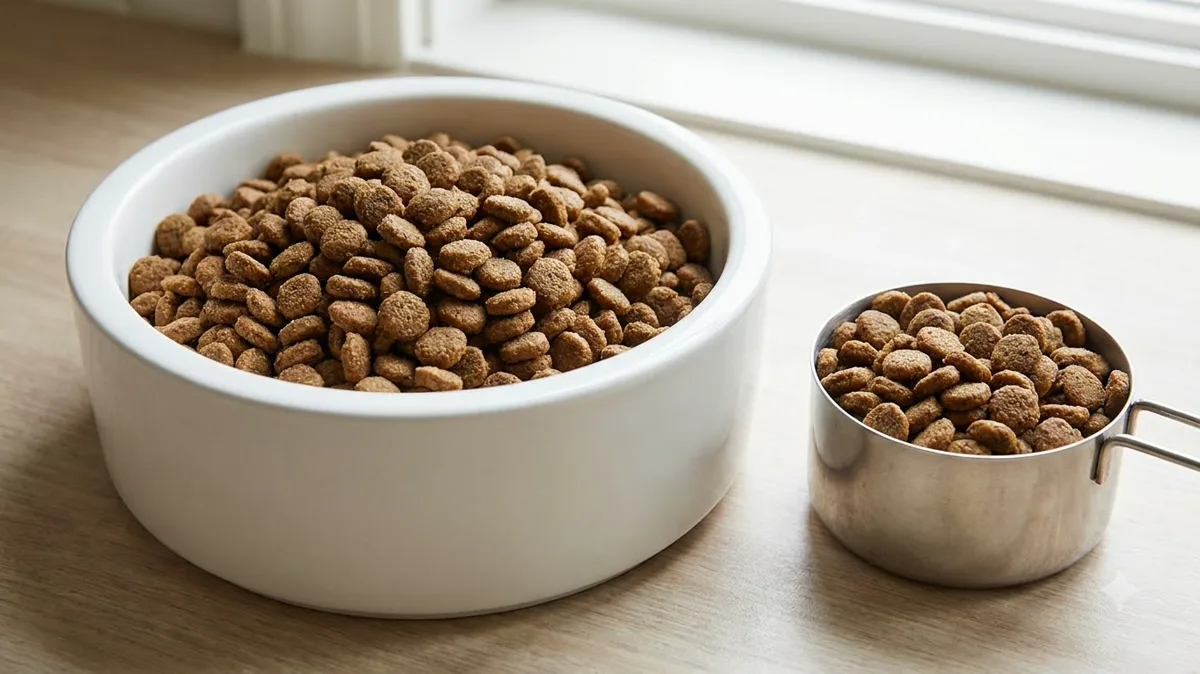
The five failures I see most often, in order of how much damage they do: feeding to the dog’s hoped-for weight instead of its current weight; measuring by scoop instead of by grams; forgetting that treats, chews and table scraps are calories; using the puppy factor on a dog that stopped growing months ago; and never re-running the number after a neuter.
Treats deserve their own sentence. A single medium dental chew can carry seventy calories. On the 22 lb dog above, that is eleven per cent of the entire daily budget from one item, before any training rewards. If you use treats heavily, subtract them from the calculated portion rather than adding them on top of it.
The AVMA’s household hazards list names alcohol, chives, chocolate, coconut water, coffee, fatty foods, fruit pits, garlic, grapes and raisins, macadamia nuts, onions, salty snacks, tea, yeast dough and anything containing xylitol. The ASPCA notes that tartaric acid is the suspected toxic component in grapes and raisins, that dogs cannot process it, and that exposure can lead to kidney damage.
Avocado is worth a note because the two sources differ in emphasis: the ASPCA describes it as primarily a problem for birds, rabbits, horses and ruminants, while the AVMA still lists it among foods to keep off the menu. If your dog has eaten any of these, call your veterinarian rather than waiting for symptoms.
4-2. 🤔 My rule: let the ribs overrule the arithmetic
Here is the judgement I would defend against any calculator, including my own. Run the number, feed it for two weeks, then put your hands on the dog. If you cannot feel the ribs under light pressure, cut the portion by ten per cent and wait another two weeks. If the ribs feel sharp, add ten per cent. The scale and your hands beat the formula every time, because the formula cannot see metabolism, and metabolisms vary by more than the multipliers do.
The trap in the other direction is impatience. Two weeks is the minimum honest observation window; anything shorter is measuring water and gut fill, not body fat. And if a dog is losing or gaining weight on a portion that the arithmetic says should be correct, that is a reason to book an exam, not a reason to keep adjusting the number.
🐶 Puppies, seniors and neutered dogs
5-1. 🍼 Growth changes the target every few weeks
A puppy’s factor is high because growth is expensive, and its weight is a moving target. That combination means a portion calculated in week ten is wrong by week fourteen. Re-run the dog food calculator every time the puppy gains meaningful weight, and split the daily amount across three or four meals rather than two — small stomachs handle frequency better than volume.
Choose the food for the life stage as well as the amount. The FDA’s explanation of “complete and balanced” is useful here: a food formulated for adult maintenance is not formulated for growth, and a growing puppy fed a maintenance diet is being shortchanged on more than calories.
5-2. ✂️ After a neuter, the budget drops the same day
Neutering lowers the multiplier — in our table, from 1.8 to 1.6 at normal activity. On a 50 lb dog that is roughly 130 calories a day, about 37g of dry food. Keep feeding the old portion and the surplus accumulates quietly for months before anyone notices. The fix is to re-run the number at the post-operative check, not at the next annual visit.
Seniors move the other way and for a different reason: activity falls faster than appetite. Our table drops a neutered senior to 1.4, but this is also the life stage where an unexplained weight change matters most clinically, so a senior losing weight on an adequate portion belongs in front of a veterinarian rather than in front of a bigger bowl.
❓ Dog food calculator FAQ
6-1. ❓ How much should I feed my dog per day?
Calculate the resting energy requirement as 70 × weight-in-kg^0.75, multiply by the life-stage factor, then divide by your food’s calories per 100g. For a 22 lb neutered adult on a 350 kcal/100g dry food that is about 180g, or 6.3 oz, a day. Weigh the food rather than scooping it, and re-check the dog’s body condition after two weeks.
6-2. ❓ Is a dog food calculator more accurate than the bag chart?
It is more specific, which usually means closer. Bag charts are required to give a weight of food per weight of animal, but AAFCO itself calls feeding directions guidelines that may need modification. A calculator can take your dog’s exact weight, neuter status and activity level into account, so it narrows the range. Neither replaces looking at the dog.
6-3. ❓ How many cups is the calculated amount?
Divide the daily calories by the kcal-per-cup figure in your bag’s Calorie Content statement. That is the only conversion that is true for your specific kibble, because cup weight varies with kibble size and density. A kitchen scale set to grams removes the guesswork entirely and costs about the price of two bags of food.
6-4. ❓ Why does wet food need such a large portion?
Because most of it is water. A wet food at 85 kcal per 100g carries roughly a quarter of the energy of a 350 kcal dry food, so the same calorie target needs about four times the weight of food. The calorie count is what matters; the mass on the plate is a consequence of the moisture content.
6-5. ❓ How often should I re-run the numbers?
Every few weeks for a growing puppy, immediately after a neuter or a diet change, and at least twice a year for a healthy adult. Also re-run them any time the dog’s activity pattern changes for a season — a dog that hikes all summer and sits out a cold winter is effectively two different dogs on this chart.
RER = 70 × kg^0.75, DER = RER × life-stage factor, portion = DER ÷ calories per 100g. A 22 lb neutered adult on standard dry food lands near 180g or 6.3 oz a day. Take the calorie figure from the Calorie Content statement, divide kcal/kg by ten, weigh the food in grams, and let a two-week body-condition check correct the estimate. Treats count, neutering lowers the factor, and wet food weighs four times as much for the same energy.
Open the dog food calculator and check your dog’s portion →
Ad
UNOVE Deep Damage Repair Hair Mask5% off with code JXLAB0306View details ›
Affiliate link — I may earn a commission.
📚 Sources and disclaimer
7-1. 🔗 What was cited above
Ohio State University Veterinary Medical Center — Basic Calorie Calculator for Dogs and Cats
AAFCO — Reading Labels: Feeding Directions and Statements of Caloric Content
U.S. FDA — “Complete and Balanced” Pet Food
ASPCA Animal Poison Control — People Foods to Avoid Feeding Your Pets
AVMA — Household Hazards
WSAVA — Global Nutrition Guidelines
7-2. 🩺 Disclaimer
This article is general information, not veterinary advice, and every figure in it is an estimate for reference. Real energy needs vary with metabolism, body condition, health status and the exact food in the bowl. Guidelines from AAHA, AVMA, AAFCO and university veterinary centers are cited as published; they are not a substitute for an examination. Before changing a feeding amount or a diet, ask the veterinarian who knows your dog. If you think your dog has eaten something toxic, contact your veterinarian or a poison control service immediately rather than waiting for symptoms.