
Blood Moon Total Lunar Eclipse: Why Aug 28 Was Partial
Checked 29 Aug 2026 (KST) · NASA SVS 5672
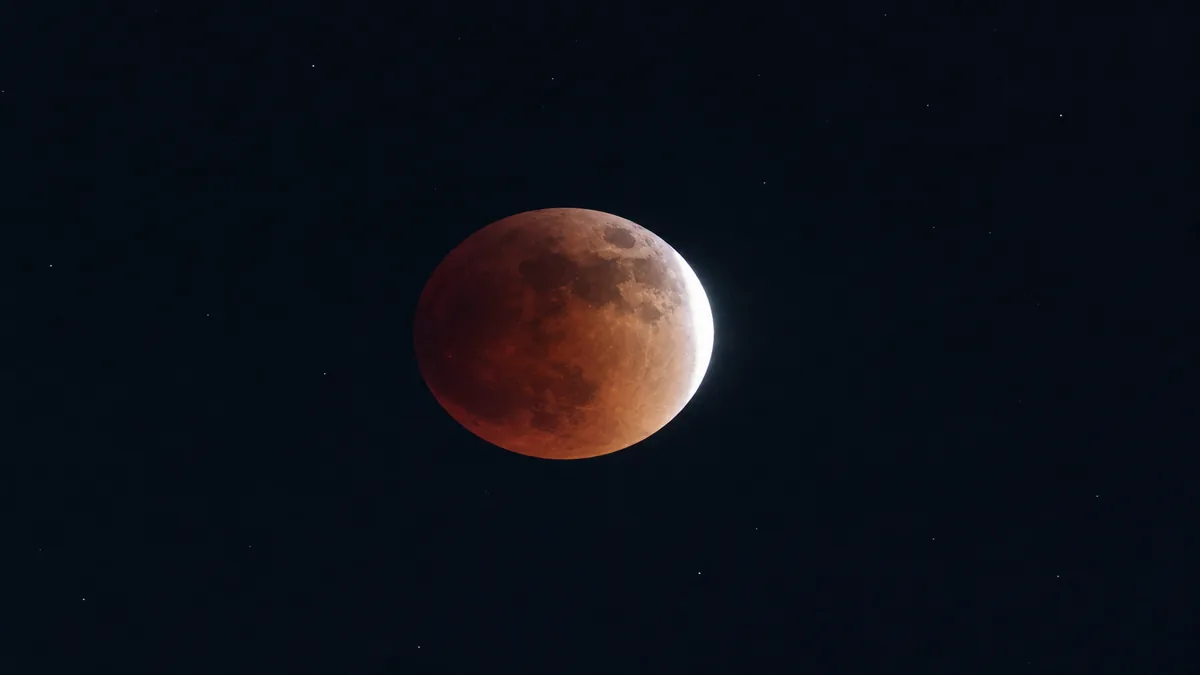
A blood moon total lunar eclipse is what a lot of people typed last night. US search interest in that exact cluster was reported in the 500,000-plus range. NASA did not log totality. NASA Scientific Visualization Studio item 5672 titles the event a deep partial lunar eclipse on 27–28 August 2026, with greatest eclipse at 4:13 a.m. Universal Time, when 96.3% of the Moon’s disk sat in Earth’s umbra.
That leftover sliver is the whole argument. A total lunar eclipse needs the entire disk inside the umbra. A deep partial can still turn copper-red after your eyes adapt — NASA’s own note on this visualization — without ever becoming totality. If you watched a red Moon and filed it under “total,” the catalog and the search box were not talking about the same thing.
This write-up is a reading of those NASA pages, not a weather log for your backyard and not medical advice about anyone’s eyes. I converted 04:13 UT to 13:13 KST (UTC+9) as a clock conversion only. Korea is not in the SVS visibility sentence. Treat that timestamp as arithmetic, not as a Seoul viewing window.
Deep partial, not total. Greatest eclipse 04:13 UT on 28 August 2026. 96.3% of the disk in the umbra — that 96.3% is obscuration (area), which SVS 5672 is careful to separate from umbra magnitude (a fraction of the Moon’s diameter).
You were looking at the Moon in Earth’s shadow. NASA’s eclipse-safety page is written for looking at the Sun. Do not copy solar-filter rules onto this event.
🌑 What NASA SVS 5672 actually shows
SVS pages are the studio’s own visualizations, with an ID, a release date, and a credits block. Item 5672 was released Friday 21 August 2026 and the fetched page showed a last update on Tuesday 25 August 2026 at 5:58 p.m. EDT. The visualizer credited is Ernie Wright. The headline on that page is not “total.” It is “August 27-28, 2026 Deep Partial Lunar Eclipse.”
The body text is blunt. On 28 August 2026 — the evening of the 27th in some time zones — the Moon passes into Earth’s shadow and creates a deep partial eclipse. At greatest eclipse, 4:13 a.m. Universal Time, 96.3% of the Moon’s disk is within Earth’s umbra, “the central part of the shadow where the Sun is completely blocked by Earth.” The remaining slice is why the word total does not apply.
1-1. 📉 Deep partial, not a near-miss of language
“Almost all of it was dark” is a fair backyard sentence. “Total” is a catalog word. NASA’s Moon & Eclipses explainer defines a partial lunar eclipse as an imperfect alignment in which the Moon passes through only part of Earth’s umbra. The shadow grows and recedes “without ever entirely covering the Moon.” That is the class SVS 5672 put this night in. The Moon page’s own upcoming table lists “August 28, 2026 (UTC)” as Partial.
A blood moon total lunar eclipse headline is easy to write when the umbra has already eaten most of the disk and the leftover crescent is hard to notice with a phone camera. The catalog still waits for 100% of the disk. 96.3% is a lot of shadow. It is not the last 3.7%.
SVS also notes the coppery color. After the partial phase has been underway long enough that the sunlit remainder is small, observers’ eyes can adapt and pick up the umbral copper. The visualizations even mimic that dark adaptation by raising the apparent photographic exposure near greatest eclipse. Color is not a totality badge. NASA’s blood-moon explainer on the Moon page is about sunlight filtered through Earth’s atmosphere — all the world’s sunrises and sunsets projected onto the lunar surface — during a lunar eclipse, including totals. Partial events can still look red without crossing the class line.
1-2. 📐 96.3% is obscuration, not magnitude
SVS 5672 spends a whole section on this, because the two percentages get swapped in headlines. Umbra magnitude, the number on Fred Espenak’s NASA eclipse site, is the fraction of the Moon’s diameter covered by the umbra. Obscuration — “the 96.3% number here” — is the area covered by the umbra. Magnitude can be greater than 1.0 (how deep totality went) or negative (penumbral, missed the umbra). Obscuration stays between 0 and 1 and matches what you think you saw: how much of the disk was in the dark core.
This article does not invent a magnitude number for 28 August 2026. The fetched SVS page explains the difference and prints obscuration. If another NASA table lists magnitude, it belongs in a later update after that table is opened. Mixing the two is how 96.3% becomes “basically total” in a group chat.
Saros 138 is the family. SVS says eclipses in a saros series are separated by 18 years, 11 days, 8 hours. The previous member was 16 August 2008; the next is 7 September 2044. That is family history, not a promise that 2008 looked like 2026 from your driveway.
🔎 Why a blood moon total lunar eclipse search is not a class
People do not search NASA IDs. They search the sentence they already heard. “Blood moon” is the color nickname. “Total lunar eclipse” is the class word that got glued on. “Tonight” is the urgency. Put together, the query blood moon total lunar eclipse tonight is a reasonable thing to type at 11 p.m. if the Moon looks wrong. It is a bad thing to treat as a classification.
2-1. 🩸 Blood moon is a color story
NASA’s Moon page explains the nickname without making it a legal type. During a lunar eclipse, leftover sunlight is filtered through a long path in Earth’s atmosphere. Blues scatter; longer wavelengths get through; the Moon can look orange or red. Dust and clouds in that atmosphere can push the color redder. None of that paragraph requires the eclipse to be total. A deep partial can show the same copper on the umbral part of the disk once your eyes stop being dazzled by the still-lit rim.
That is why last night’s photos and last night’s catalog fought each other. A cropped image of the red sector looks like every total-eclipse postcard. The SVS diagram, with UTC stamps left behind along the Moon’s path through penumbra and umbra, still labels the night partial. Believe the diagram for the class. Keep the photo for the color.
2-2. 📈 Half a million searches is not a NASA stamp
The 500,000-plus US figure for that search cluster is a third-party trend estimate that we did not verify. Treat it as demand, not as an official count of eclipses. Search volume can be right about curiosity and wrong about geometry in the same hour. The correction is one sentence: NASA SVS 5672, deep partial, 96.3% obscuration, 04:13 UT.
If a news recap used “total” because the Moon looked fully painted, that recap is downstream of the nickname, not upstream of the catalog. Time order is not cause. Searches spiked; NASA had already posted the visualization (release 21 August, before the night). The page was not written to chase the query. The query chased the sky.
| What people typed | NASA SVS 5672 | Keep / drop |
|---|---|---|
| Class word | Deep partial lunar eclipse, 27–28 Aug 2026 | Drop “total” |
| Coverage | 96.3% of the disk in the umbra (obscuration, not magnitude) | Not 100% = not totality |
| Color nickname | Copper possible after eyes adapt; color is atmosphere, not a class | Keep “blood moon” as color only |
| US search cluster | Demand reported 500,000+ (unverified estimate) | Demand ≠ catalog |
Ad
 Anua PDRN Hyaluronic Capsule 100 Serum5% off with code JXLAB0306View details ›
Affiliate link — I may earn a commission.
🕒 Clock conversion: UT to KST
Universal Time is the stamp SVS uses. Local civil time is someone else’s arithmetic. Greatest eclipse at 04:13 UT on 28 August 2026 is 13:13 KST on 28 August 2026 if you add nine hours (KST = UT+9). That sentence is a conversion. It is not a claim that the Moon stood over Seoul at 1:13 p.m., and it is not a claim that the event was visible from the Korean peninsula.
3-1. 🗓️ 04:13 UT is the NASA clock
SVS prints greatest eclipse as 4:13 a.m. Universal Time. Partial phase begins at 2:34 UTC. For US East Coast readers, NASA already did one conversion on the same page: 2:34 UTC is 10:34 p.m. Eastern on the night of the 27th. That Eastern line is NASA’s. The KST line is ours, labeled as conversion, using the standard UT+9 offset. If a government time-service page disagrees on a leap-second curiosity, this article is not that page.
Partial start 02:34 UT converts, by the same offset, to 11:34 KST on 28 August. Again: conversion. Visibility is a map, not a clock. A timestamp can be correct in Seoul while the Moon is below the horizon or outside the contour NASA drew.
| Event (SVS 5672) | Universal Time | Other clock |
|---|---|---|
| Partial phase begins | 02:34 UTC, 28 Aug 2026 | NASA: 10:34 p.m. Eastern, night of the 27th. Conversion: 11:34 KST 28 Aug (UT+9) |
| Greatest eclipse | 04:13 UT, 28 Aug 2026 | Conversion: 13:13 KST 28 Aug (UT+9). Not a Seoul visibility window |
| Umbra coverage at greatest | 96.3% of the disk (obscuration) | Leftover ~3.7% is why the class is partial |
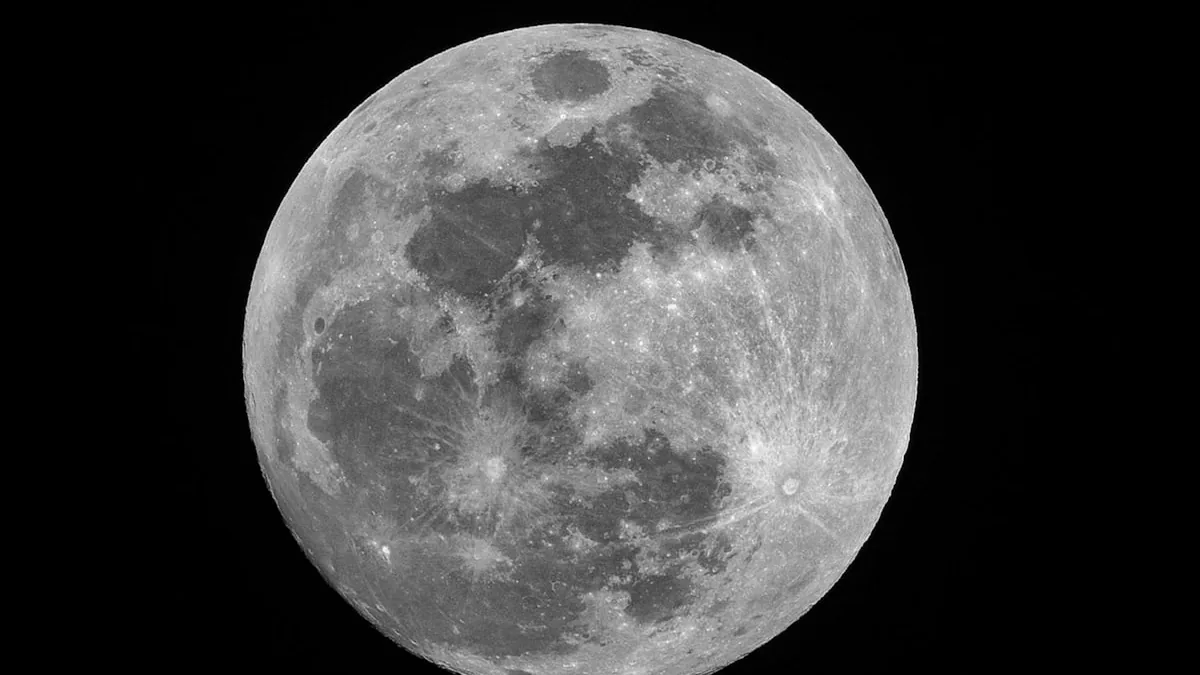
The disk above is a sunlit full Moon, not last night’s umbra. Keep that picture for the leftover sliver in a deep partial: it is still Moon, still gray-white where the umbra has not arrived. SVS 5672’s 96.3% is the other part of the same disk.
3-2. 🌙 “Last night” depends on the ocean you stood on
For much of the Americas, greatest eclipse sat in the small hours of 28 August, which still felt like “last night” on the 27th. SVS says so in one clause: evening of the 27th in some time zones. For a reader in Korea on the morning of the 29th, “last night” is already a day later than greatest eclipse, and greatest eclipse itself was an afternoon UT+9 clock. Do not flatten those three clocks into one anecdote.
If you stayed up with a pot of stew while the US East Coast waited on 10:34 p.m., that is hospitality, not astronomy. Korean recipes live elsewhere on this site — kimchi jjigae and samgyetang among them — and they do not classify eclipses. They are here so internal links go to real posts, not to a feeding tool.
🗺️ Who was in the visibility paragraph
SVS 5672’s visibility sentence for this part of the eclipse is specific: the Americas except Alaska and northwestern Canada, western Europe, and western Africa. A companion world map on the same page is described as centered on 63°8′W, the sublunar point at greatest eclipse, with contours for each phase and gray areas outside those contours. The map itself stays on the NASA page; the visibility sentence above is what this article relies on.
4-1. 🌎 SVS 5672 first
If you were in the excluded Alaskan and northwestern Canadian slice, NASA’s own exception is the line to quote, not a social-media “the whole continent saw it.” If you were in eastern Asia, you are not in that SVS sentence. This article will not upgrade “not listed” into a custom horizon diagram for Busan or Tokyo. Open the SVS page and the visibility map there.
The Moon page table is slightly broader in wording: East Pacific, Americas, Europe, Africa. That is a different NASA page, summarizing type and region for an upcoming-eclipses table. For the 27–28 August event as visualized, SVS 5672 is the page that names western Europe, western Africa, and the Alaska/northwest Canada exclusion. Keep both; do not average them into one coast.
4-2. ☁️ Weather is not in the catalog
A contour on a visibility map is geometry. Clouds, a downtown glare, a tree, a building — none of that is in SVS 5672. If your sky was socked in, the catalog is still partial and still 96.3% at 04:13 UT. If your sky was clear and the Moon looked fully red, the catalog is still partial. Backyard luck does not rewrite umbra coverage.
Pets on a late walk are not a data source either. If you keep a dog’s shot record handy for other nights, that guide is the dog vaccination schedule by age on this site. It has nothing to say about umbra magnitude. It is a published English post, which is the only reason it is linked.
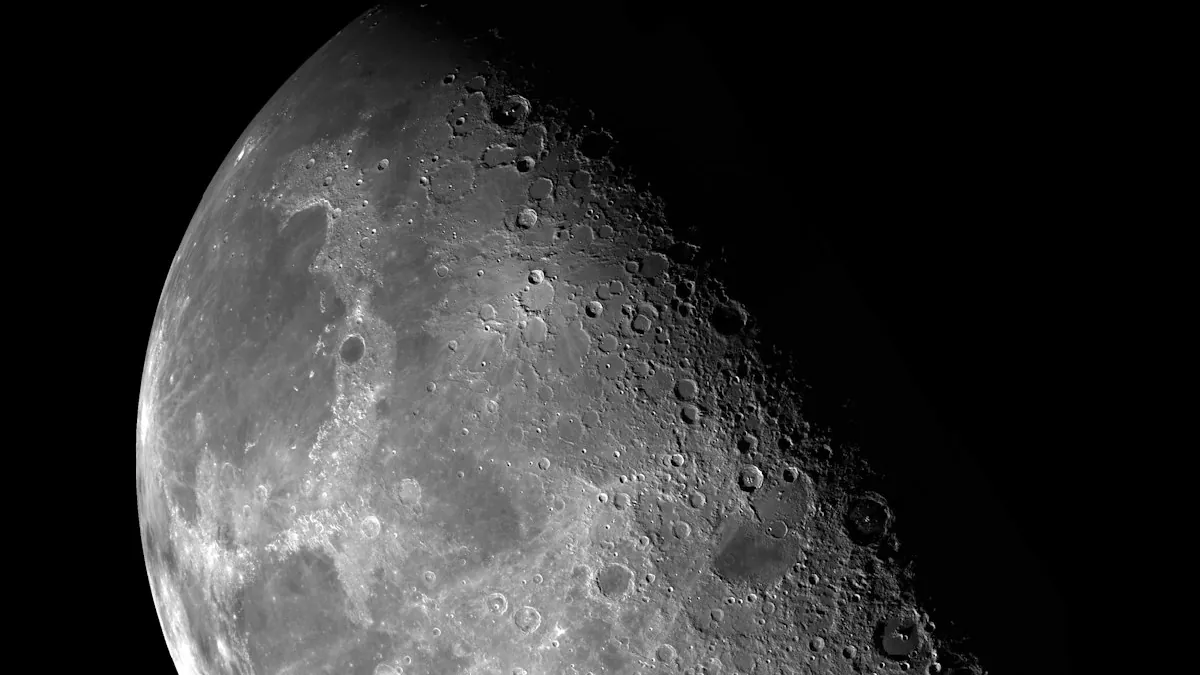
A terminator like the one above is a phase — sunlight missing the far side because of orbital geometry. An umbral eclipse is Earth’s shadow on a full Moon. Do not file last night under “the Moon looked bitten, so it was a phase.” SVS 5672 is the shadow case, and it was still not total.
👁️ Eyes: lunar shadow vs solar disk
This is the other mix-up the search created. Eclipse glasses, ISO 12312-2, “never look at the Sun” — those sentences live on NASA’s solar safety page. A lunar eclipse is Earth’s shadow on the Moon. You are looking at the Moon. Those are different targets. This section will not pretend the safety page issued a lunar slogan it did not print.
5-1. 🌕 You were looking at the Moon
NASA’s lunar explainer opens with the split: during a lunar eclipse, Earth’s shadow obscures the Moon; during a solar eclipse, the Moon blocks the Sun from view. SVS 5672 is the lunar case. The bright object in the sky was the full Moon sliding through penumbra then umbra. It was not the Sun’s face.
That distinction is the useful one. It does not require a medical claim. If your eyes hurt, that is a clinician’s problem, not a blog classification. If someone handed you solar eclipse glasses for this event, they applied the wrong chapter. The glasses are for the Sun.
5-2. ☀️ NASA’s safety page is a solar page
Eclipse Viewing Safety on NASA Science is explicit about its subject. Except during the brief total phase of a total solar eclipse, it is not safe to look directly at the Sun without specialized eye protection for solar viewing. Partial and annular solar eclipses never have a safe naked-eye stare at the Sun. Regular sunglasses are not enough. Viewers should meet ISO 12312-2. Do not look at the Sun through a camera, binoculars, or telescope without a proper solar filter on the front of the optics. Supervise children. That is the page, quoted in paraphrase, about the Sun.
The fetched safety page does not say “lunar eclipses are safe to view with the naked eye.” This article will not hang a fake NASA quote on that gap. The honest line is narrower: solar-filter rules are for looking at the Sun; 27–28 August 2026 as logged by SVS 5672 was a lunar eclipse. If you want a clinician’s eye-safety ruling, that is outside this page.
Skin advice on the same NASA safety page (sunscreen, hat, hours in direct sun) is also solar-event language. Do not import it as if a night-time lunar watch were a beach day. Read the page for what it is.
Times, percentages, and class words here come from NASA pages cited below. They are not a forecast for your horizon, not a substitute for a doctor, and not a reason to stare at the Sun. Individual eyes and local skies are yours to check.
Ad
Anua PDRN Hyaluronic Capsule 100 Serum5% off with code JXLAB0306View details ›
Affiliate link — I may earn a commission.
❓ FAQ
The blood moon total lunar eclipse query described a color and a class NASA did not pair for this night. SVS 5672: deep partial, greatest 04:13 UT 28 Aug 2026, 96.3% of the disk in umbra. KST 13:13 is a UT+9 conversion, not a Seoul visibility claim. Solar safety rules stay on the solar page.
6-1. ❓ Was last night a blood moon total lunar eclipse?
NASA did not class 27–28 August 2026 as total. SVS 5672 calls it a deep partial lunar eclipse. Greatest eclipse left 96.3% of the disk in the umbra. A red Moon can still happen in a deep partial. The leftover sliver is why “total” is the wrong word.
6-2. ❓ Why did people search blood moon total lunar eclipse tonight?
That is the sentence the sky suggested: color (blood moon) plus class (total) plus timing (tonight). US search interest in that cluster was reported above 500,000. Demand is not a catalog. The NASA visualization for the night was already titled deep partial.
6-3. ❓ What time was greatest eclipse in Korea Standard Time?
04:13 UT plus nine hours is 13:13 KST on 28 August 2026. That is a conversion from Universal Time, labeled as such. SVS 5672’s visibility sentence does not list Korea. Do not read 13:13 as a local viewing appointment.
6-4. ❓ Is 96.3% the same as totality?
No. SVS 5672 prints 96.3% as obscuration — the fraction of the disk’s area inside the umbra. Totality would put the whole disk in the umbra. The studio also warns not to confuse obscuration with umbra magnitude (diameter fraction).
6-5. ❓ Do I need eclipse glasses for a lunar eclipse?
NASA’s safety page is about looking at the Sun. A lunar eclipse is Earth’s shadow on the Moon. Do not copy solar-filter instructions onto SVS 5672. The safety page, as fetched, does not print a “naked-eye lunar” slogan; this article will not invent one. Eye pain is a clinical question.
6-6. ❓ When is the next one in this series?
SVS 5672 places this eclipse in Saros 138. The next member in that series is 7 September 2044. NASA’s Moon page also lists a penumbral lunar eclipse on 20 February 2027 (UTC). Different type, different night. Use the type word NASA printed, not the nickname from this week.
Sources:
- NASA SVS 5672 — August 27-28, 2026 Deep Partial Lunar Eclipse (released 21 Aug 2026; page update 25 Aug 2026)
- NASA Science — The Moon & Eclipses (upcoming table lists 28 Aug 2026 UTC as Partial)
- NASA Science — Eclipse Viewing Safety (solar viewing; not a lunar slogan)
Figures are from the NASA pages linked above and from a supplied US search-trend number that was not re-opened here. They are reference estimates for this write-up. Horizon geometry at a street address, cloud cover, and personal eye health are outside the catalog. This is not medical advice.